Toddler Crafts: A Practical Guide to Choosing Supplies, Kits, and Activities
We may earn a commission for purchases made using our links. Please see our disclosure to learn more.
Finding toddler crafts that are enjoyable for your child—and manageable for you—can feel surprisingly complicated. Some kits contain pieces meant for older children, while others create more setup than actual play. You may also wonder whether guided projects, washable paint, reusable activity pads, or modeling materials offer the best value.
This guide will help you compare craft formats, choose age-appropriate supplies, plan for cleanup, and avoid buying a cabinet full of similar materials. You will also find six carefully selected products for different budgets, homes, attention spans, and creative styles. A picture-perfect outcome is not the aim. It is a craft routine that fits your child’s abilities and your real family life.
What Makes Toddler Crafts Worth Buying?
The best toddler crafts invite action quickly. A young child should be able to dab, scribble, stamp, roll, press, or reveal colors without a long adult-led setup. If instructions demand precise folding or a polished shape, the grown-up often completes the project.
Before buying, check the age label, tool size, refill needs, and cleanup. Good value comes from repeat use—not the largest box.

Recommended Toddler Crafts Products
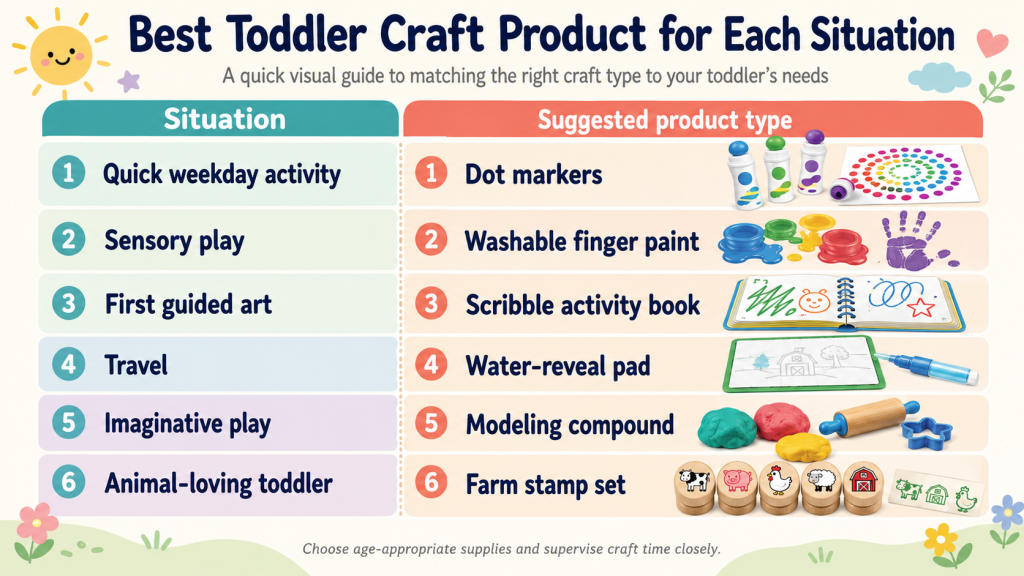
These recommended toddler crafts cover low-mess, sensory, guided, open-ended, portable, and storytelling-focused play. Each option serves a different family situation.
| Product | Best use | Mess level | Listed age |
| Do A Dot Art! Rainbow Markers | Fast dot art | Low–moderate | 3+ |
| Crayola Washable Finger Paints | Sensory painting | High | 3+ |
| ALEX My First Scribble | Guided first art | Low | 2+ |
| Water Wow! Vehicles | Travel | Very low | 3+ |
| Play-Doh Starter Set | Modeling | Moderate | 3+ |
| Farm Animal Stamp Set | Story scenes | Moderate | 3+ |
Do A Dot Art! Markers 6-Pack Rainbow Washable Paint Markers, The Original Dot Marker, Activity Craft Coloring Supplies for Kids and Toddlers, Made in USA
Best for: Quick setup and open-ended dot art
With these broad sponge daubers in this six-color set, kids can make dots, trails, layers, and big marks without having to control a narrow tip. The washable markers work well for short sessions and simple paper setups. However, the current listing sets a minimum age of three and includes a small-parts warning, so follow the label closely.
Crayola Washable Finger Paints, 6 Count
Best for: Sensory-focused painting at home
Six colors in squeeze bottles give toddlers room to smear, mix, and print with their hands. The paint is designed to wash from skin and washable clothing, while flip-top bottles help adults portion smaller amounts. Still, finger painting is genuinely messy; protect the surface, use old clothes, and note that the manufacturer’s minimum age is three.
ALEX Discover My First Scribble Kids Art and Craft Activity
Best for: Two-year-olds beginning guided mark-making
This sturdy 50-page activity book offers simple prompts and 69 stickers, giving a hesitant scribbler structure without demanding a precise picture. It is listed for children age two and older, making it one of the few choices here aimed at younger toddlers. Because the pages are consumable, it offers less repeat value than reusable activity pads.
Melissa & Doug On The Go Water Wow! Mess Free Coloring Book, Reusable Water-Reveal Activity Pad, Vehicles, for Toddlers and Kids Ages 3+
Best for: Travel, waiting rooms, and compact homes
A refillable water pen reveals color across four reusable vehicle scenes, then the pages dry and reset. The pen stores in the cover, making this a practical, low-clutter option for bags and small spaces. It is listed for ages three to seven; however, the limited page count may feel repetitive for children who prefer completely open-ended drawing.
Play-Doh Starter Set 9-Piece Kit with Storage Tote and 4 Modeling Compound Cans
Best for: Modeling, tool practice, and imaginative play
This starter kit includes four two-ounce compound cans, nine tools, and a reusable storage bag. Children can roll, cut, stamp, and invent pretend foods or creatures, so the activity changes from one session to the next. The set is labeled for ages three and up. The compound contains wheat and needs prompt resealing to reduce drying.
Melissa & Doug My First Wooden Stamp Set – Farm Animals
Best for: Older toddlers who enjoy stories and animals
Eight farm-animal stamps have flat wooden handles for young hands, while two washable ink pads support simple scenes and storytelling. Everything stores in a wooden crate, which helps contain loose pieces. The minimum age is three. Ink still needs supervision, and the pads can become messy or dry out when children leave them open.

Choose Supplies by Age, Not Aspirational Skill
Age labels provide an essential first filter, although children develop at different rates. Younger toddlers usually do better with large tools, short activities, and immediate cause-and-effect. Later, introduce stickers, stamps, child-safe scissors, and brushes.
The American Academy of Pediatrics notes that two-year-olds commonly make broad vertical and circular strokes, while three-year-olds show more interest in clay, paint, crayons, and scissors. Buy for the child in front of you.
Pick Materials That Match Your Cleanup Tolerance
“Washable” helps, but it does not guarantee every pigment will leave every fabric or unfinished surface. Test unfamiliar supplies, cover porous tables, and keep a damp cloth nearby.
For easier toddler crafts, choose water-reveal pads, washable markers, crayons, or small portions of dough. Finger paint and glue collages offer richer sensory play but need preparation. Flip tops, built-in pen storage, and totes also reduce spills.
Best Options for Small Homes and Travel
In a compact home, toddler crafts should earn their shelf space. Reusable products usually work harder than single-project kits and create less clutter.
For travel, choose one self-contained activity and avoid glitter, beads, tiny foam pieces, or anything needing a drying rack. A water pad fits in a bag, while dot markers and paper share one small bin. Even ten calm minutes in a waiting room is useful.
Open-Ended Art or Step-by-Step Kits?
Open-ended art lets children decide what to do. Stamping, scribbling, paint mixing, and dough modeling adapt to different abilities. Guided kits can suit children who enjoy imitation or seasonal keepsakes, but the toddler should still make meaningful choices.
A balanced shelf might hold one open-ended medium, one portable reusable activity, and one guided book—enough variety without constant planning.
Research-Backed Benefits of Toddler Crafts
Professional guidance supports hands-on art as one useful part of early development, although evidence does not show that a particular commercial kit creates superior outcomes. The National Association for the Education of Young Children’s fine-motor guidance recommends finger painting, brushes, child-safe scissors, play dough, crayons, and markers for small-muscle practice.
Head Start’s early STEAM guidance connects scribbling and open-ended art with exploration, communication, problem-solving, and creative thinking. The American Academy of Pediatrics’ toy guidance adds that useful art materials can be simple and inexpensive. In practice, variety, repetition, and shared interaction matter more than elaborate packaging.
Safety and Supervision Come Before Creativity
Always follow the current age label and warnings. Children under three need particular protection from small parts, and all toddlers require active supervision because supplies can move from table to mouth quickly.
The American Academy of Pediatrics’ art-supply safety guidance recommends child-intended products and generally favors water-based supplies over solvent-containing materials. The U.S. Consumer Product Safety Commission confirms that children’s craft products face labeling and safety requirements, including small-parts rules. Keep adult tools, magnets, button batteries, water beads, and choking-size decorations away.
Set Up Craft Time Without Creating a Battle
Prepare the surface before inviting your child over. Put out two or three colors, one tool, and one work area; too many choices invite dumping and cap swapping.
Start with small portions. Describe what your toddler does instead of directing the result: “You made a long red line” allows more ownership than “Put red here.” Stop while the experience is pleasant. A calm ten-minute session beats an hour ending in tears.
Rainy-Day Toddler Crafts That Hold Attention
On a wet afternoon, rotate movements: try standing art, seated dough play, then a water pad or sticker book. Farm stamps, pretend bakery dough, dotted raindrops, or scribbled roads add direction without controlling the result.
For more movement, sensory, and quiet options, pair craft time with fun indoor toddler activities for screen-free play. It helps when paint loses its charm but bedtime remains far away.
Seasonal Crafts and Keepsakes Without Pressure
Seasonal toddler crafts feel more meaningful when the child’s contribution stays visible. Use a painted background, handprint, stamp cluster, or freely placed stickers instead of assembling most of the project yourself.
Add the child’s name and date, photograph bulky creations, and save only a few favorites. A purple snowman is not a failed project; it shows genuine participation.
How Much Should You Spend?
Start with paper, washable crayons or markers, one paint option, and modeling dough. Add a portable activity when your routine creates a clear need.
Think in cost per session, not package size. Reusable pads, stamps, and durable tools may justify a higher initial cost. A huge box offers poor value if half the contents are too advanced or duplicate supplies you own. Spend on age-appropriate design and materials you will actually use.
Store and Rotate Supplies So They Get Used
Keep everyday toddler crafts in one adult-accessible bin. Separate crayons and water pads from sealed dough and messier paint or stamps.
Rotate items every week or two; a familiar set can feel new after a break. Wipe caps, close containers, and count loose tools, especially around younger siblings. Store supplies where setup is realistic—perfect organization means little when the bin is buried behind holiday decorations.
FAQs About Toddler Crafts
What are the best toddler crafts for a two-year-old?
Choose large crayons, chunky washable markers, simple stickers, soft modeling material labeled for that age, finger paint with close supervision, or a sturdy scribble book. Look for whole-hand movements and immediate cause-and-effect rather than precise cutting or assembly. Always follow product age guidance because many popular craft tools are labeled for ages three and older.
How long should a toddler craft activity last?
Let your child’s engagement set the length. Five to fifteen focused minutes may be plenty, while a favorite sensory activity may last longer. Prepare a short experience rather than expecting a fixed lesson. When your child repeatedly leaves, throws materials, mouths supplies, or becomes frustrated, calmly end the session and try again another day.
Are craft kits better than basic art supplies?
Neither is automatically better. Basic supplies usually provide more open-ended play and lower replacement costs. Kits reduce planning and can suit a trip, theme, gift, or caregiver who prefers clear instructions. For most homes, a small core of reusable materials plus an occasional carefully chosen kit offers better variety than many single-project boxes.
How can I keep kid’s crafts from getting messy?
Limit the amount and number of colors, cover the surface, use a washable mat, dress your child in old clothes, and keep a damp cloth nearby. Water-reveal books and broad washable markers provide lower-mess alternatives. Most importantly, prepare first; opening bottles while protecting furniture with one elbow is a needlessly advanced parenting challenge.
What should I avoid in craft supplies for toddlers?
Avoid products outside your child’s age range, small loose pieces for children under three, sharp tools, solvent-based adult art products, magnets, button batteries, water beads, and hot-glue activities. Skip kits that depend on precise assembly or mostly adult-operated steps. Read each warning because two products that look similar may carry different limits or hazards.
Final Recommendation: Choosing the Right Toddler Crafts
Choose toddler crafts by matching the activity to your child’s age, preferred movements, attention span, and your available space. Do A Dot Art! markers suit quick, flexible mark-making, while the reusable Water Wow! pad works well for travel or compact homes. Families wanting richer sensory play may prefer finger paint or the Play-Doh starter set, provided the labels and cleanup needs fit.
Start with one open-ended material and one low-mess option instead of buying a huge assortment. Watch what your child repeats, then build around that interest. The strongest purchase is the one you can set up safely, supervise comfortably, and bring out often.