
Gentle Parenting: How to Raise Kids With Kindness and Boundaries

We may earn a commission for purchases made using our links. Please see our disclosure to learn more.
Your child is melting down over a broken cracker, and you have already explained three times why you cannot fix it. Should you comfort them, hold your ground, or give in to end the noise? This is where gentle parenting can feel confusing, especially when advice online makes every ordinary disagreement sound like a major parenting decision.
At its heart, this approach asks you to take children’s feelings seriously while remaining responsible for their behavior and safety. It is not about preventing tears or keeping everyone happy. It is about teaching children how to handle disappointment, cooperate, and treat others respectfully. Below, you’ll find realistic ways to set limits, respond to tantrums, choose age-appropriate consequences, and make the approach work on busy days.
What Gentle Parenting Actually Means
Gentle parenting is an approach built around empathy, respectful communication, and clear guidance rather than fear or humiliation. Parents try to understand why a behavior happened, then teach the child what to do differently.
Imagine a preschooler knocking over a tower because another child touched it. You can acknowledge the frustration without accepting the pushing that followed. The goal is not instant obedience; it’s helping a developing child learn safer responses over time. Because the label is informal, advice varies.
Gentle Parenting vs. Permissive and Strict Parenting
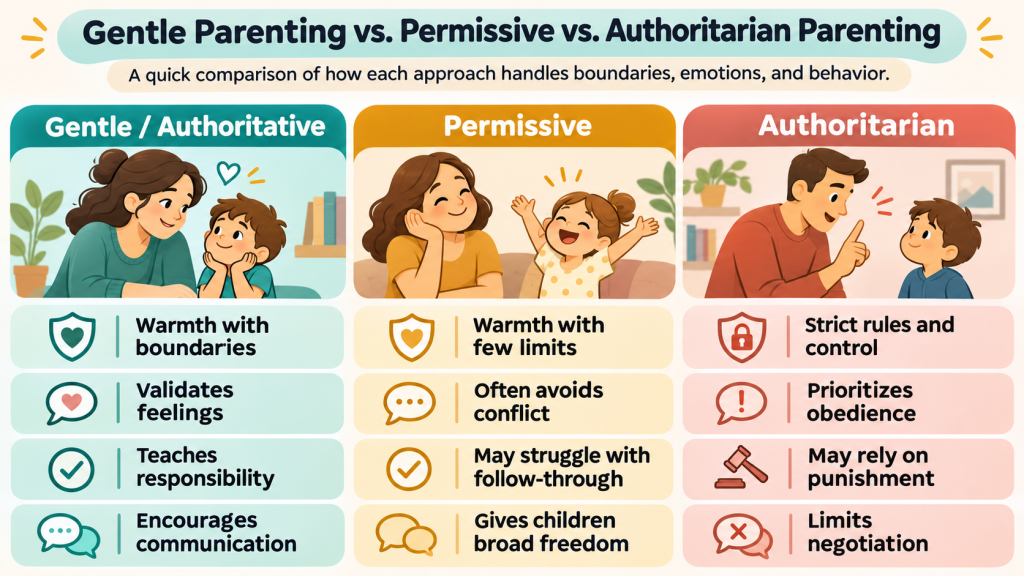
These approaches differ most in how adults handle children’s emotions and limits. Permissive parenting offers warmth but may avoid enforcing rules. Authoritarian parenting emphasizes obedience and control, sometimes at the expense of responsiveness.
Well-practiced gentle parenting more closely resembles authoritative parenting: adults remain warm and involved while setting firm expectations. Children can protest a bedtime, but bedtime still happens. You listen to the complaint, acknowledge it, and guide the routine forward. Children need adult leadership.
Three Principles That Make the Approach Work
Start with empathy: notice what your child may be experiencing before deciding how to respond. Next comes respect, which means talking without insults, threats, or ridicule, even when the behavior is frustrating.
The third principle is responsibility. You are still the adult who makes safety decisions and maintains workable household rules. Without limits, empathy becomes negotiation; without empathy, rules become power struggles.

How to Set Kind but Firm Boundaries
Make the boundary short, specific, and realistic. Instead of saying, “Stop being naughty,” try, “Crayons stay on the paper.” If your child keeps drawing on the wall, put the crayons away temporarily and help them clean up when appropriate.
Give choices within the limit rather than making the limit optional: “You can walk to the car or hold my hand.” Never make safety rules optional. Follow through calmly, even if you must repeat yourself.
Handling Tantrums Without Giving In
During a tantrum, your first tasks are keeping everyone safe and avoiding an argument that adds more distress. Move dangerous objects, stay nearby when welcome, and use brief reassurance such as, “You’re upset. I’m here.”
You do not have to reverse a sensible decision to show compassion. If screen time is finished, it remains finished even if your child cries. Explain afterward. Hunger, fatigue, and abrupt transitions can contribute, so watch for patterns.
Gentle Discipline That Still Teaches Responsibility
Discipline means teaching a better response, not merely applying punishment after a mistake. If a child throws blocks at someone, stop the throwing, remove the blocks if needed, and explain the safety rule in plain language.
Later, practice what they could say instead. For messes, an age-appropriate cleanup task can help. Keep consequences related, brief, and proportionate. Physical punishment, yelling, and shaming are poor substitutes for showing the behavior you want to see.
Teaching Kids to Recognize and Manage Emotions
Children often need help putting feelings into words before they can use coping skills. During calm moments, name familiar feelings: “You looked disappointed when the game ended.”
Practice one manageable strategy together, such as taking slow breaths, asking for space, or requesting help. Do not insist that every upset child breathe on command. Some need quiet company first. Talking about feelings after the storm is often more productive than trying to deliver a lesson during it.
Making Daily Routines Less of a Battle
Predictable routines reduce surprises, particularly for younger children. A simple sequence—breakfast, get dressed, brush teeth, shoes—can prevent several negotiations before school. Picture cards or a visual timer may help children understand what comes next.
Give one clear instruction at a time and notice cooperation specifically: “You put your shoes beside the door.” If a task keeps causing conflict, consider whether it is too complicated or rushed. Adjust the setup before repeating yourself louder.

Adapting Gentle Parenting to Different Ages
Toddlers need supervision, brief instructions, and immediate guidance. A long discussion about fairness won’t help much when a two-year-old is running toward the street; take their hand and explain afterward.
Preschoolers can practice choosing between acceptable options and naming simple feelings. School-age children can discuss consequences and responsibilities. Teens need more privacy and input, alongside safety agreements. Developmental differences matter too: a child who struggles with language, attention, or sensory demands may need adapted instructions rather than stricter consequences.
Staying Calm and Repairing Your Own Mistakes
No parent stays composed all day. If your voice rises, ensure your child is safe, pause, and use a short response. Ask another caregiver for a break if possible.
If you shout, repair it plainly: “I yelled. That was wrong. Next time I’ll take a pause.” You can apologize while keeping the original rule. For more ideas on handling these moments, Parentloom shares emotional regulation strategies for parents. Your child learns from how you handle mistakes, not from an impossible standard of constant calm.
Common Gentle Parenting Mistakes to Avoid
One mistake is explaining too much while a child is overwhelmed. Another is asking permission for a decision that isn’t optional, such as wearing a seat belt. Repeated warnings without follow-through can also make boundaries confusing.
Validation is not agreement: “I see you’re angry” never means “You may hit.” No magic phrase prevents every tantrum. Finally, don’t turn emotional coaching into another demand. Some children need time, movement, or quiet before they want to talk.
What Research and Pediatric Guidance Support
A 2025 review of parenting styles and interventions found that responsive caregiving and clear, consistent structure are linked with healthier child development. It describes authoritative parenting—high warmth paired with firm boundaries—as generally associated with favorable outcomes. Much of the evidence on parenting styles is observational, so these associations do not prove that one label causes every outcome.
The American Academy of Pediatrics’ 2018 policy statement, reaffirmed in 2024 advises against spanking and harsh verbal discipline and supports constructive, age-appropriate guidance. The CDC’s 2026 advice on giving directions recommends simple instructions, limited choices, and consistent follow-through. These sources support specific practices, not a guarantee that anything branded “gentle parenting” will work for every family.
Helpful Products for Gentle Parenting
No book or tool can replace patience and consistent limits. These five options serve different needs, from finding useful language to making feelings and routines easier to discuss.
How to Talk so Little Kids Will Listen: A Survival Guide to Life with Children Ages 2–7 by Joanna Faber and Julie King
Best for: Parents looking for practical scripts to improve communication.
This parenting book explores everyday conflicts such as refusing to get dressed and arguing with siblings. Its examples help adults practice acknowledging feelings, giving choices, and inviting cooperation without long lectures. It focuses on ages two through seven, so parents of older children may prefer a resource aimed at their child’s stage.
TIME TIMER Home MOD 60-Minute Visual Timer, Fern Green
Best for: Families struggling with activity transitions.
The shrinking green disk makes remaining time visible during play, homework, or getting ready to leave. This compact timer runs for up to 60 minutes and offers an optional alert. It needs one AA battery, which is not included, and young children may still need adult reminders to understand the countdown.
Learning Resources Big Feelings Pineapple Deluxe Set
Best for: Children aged three and older learning facial expressions.
This double-sided pineapple lets children assemble different expressions with interchangeable face pieces. A mirror and feelings materials encourage playful conversations about emotional changes rather than demanding answers during a meltdown. Its small pieces create a choking hazard for children under three, and it works best when an adult joins the activity.
The Color Monster: A Story About Emotions by Anna Llenas
Best for: Shared reading about confusing feelings.
This illustrated picture book uses a colorful character to introduce emotions such as fear, anger, sadness, and happiness. Reading together gives adults an easy opening to ask children what different feelings look like. It is a conversation starter, not a step-by-step behavior program, and younger readers will need help connecting the story to real situations.
No-Drama Discipline: The Whole-Brain Way to Calm the Chaos and Nurture Your Child’s Developing Mind by Daniel J. Siegel and Tina Payne Bryson
Best for: Parents looking for a more comprehensive approach to discipline.
Siegel and Bryson explain ways to combine emotional connection with guidance during challenging behavior. The book offers examples and illustrations for thinking beyond immediate punishment. Its broader explanations require more reading than a quick-reference chart, and parents should adapt the strategies to their child’s needs rather than treating them as universal rules.
Frequently Asked Questions About Gentle Parenting
Does gentle parenting mean never saying no?
No. Saying no is sometimes necessary, especially for safety, health, and reasonable family rules. The difference is how you deliver and enforce it. You can acknowledge disappointment, explain briefly when useful, and still follow through. A child being upset by a boundary does not mean the boundary was unkind.
Is gentle parenting effective for strong-willed children?
It can provide useful strategies, but no approach guarantees cooperation. Children with intense reactions may need more advance preparation, simpler instructions, predictable routines, or extra support. Focus on recurring triggers and a consistent response rather than trying to win every disagreement. Seek professional guidance if behaviors cause injuries or seriously disrupt daily life.
Are gentle parenting and positive parenting the same approach?
The terms overlap but are not identical programs. Both often emphasize respectful relationships, encouragement, and teaching skills instead of harsh punishment. “Positive parenting” also describes specific, structured approaches used by public-health and clinical programs. Rather than relying on either label, check whether advice includes realistic expectations, clear boundaries, and appropriate consequences.
What should I do if my partner uses a different parenting style?
Start by agreeing on a few nonnegotiable household rules, such as responding promptly to hitting and following the bedtime routine. Discuss disagreements privately, not during your child’s meltdown. You do not need identical personalities or wording, but children benefit when caregivers are reasonably consistent about safety and follow-through.
When should parents get extra help with behavior?
Speak with a pediatrician or qualified child professional if aggression causes injuries, behavior worsens suddenly, or daily routines become persistently unmanageable. Ask about developmental, communication, sleep, and sensory factors where relevant. Getting support does not mean abandoning a compassionate approach; it can help you find strategies better suited to your child’s particular needs.
Conclusion: Make Gentle Parenting Practical
Gentle parenting works best as a balance of empathy and leadership. Listen to the feeling, set a clear limit, stop unsafe actions, and teach a better response when your child is ready. You do not need endless explanations or a perfectly calm voice to keep making progress.
If transitions are your biggest challenge, a visual timer may make the next step easier to anticipate. If you’re struggling to find words during conflicts, How to Talk so Little Kids Will Listen offers practical examples. Neither replaces reliable routines, age-appropriate expectations, and follow-through.
Start with one recurring conflict, such as ending screen time or getting dressed. Decide what boundary matters, how you’ll communicate it, and what calm action you’ll take when your child objects.