Simple Science Fair Project Ideas for Kids Of All Ages
We may earn a commission for purchases made using our links. Please see our disclosure to learn more.
Choosing a Science Fair Project can feel sweet and slightly terrifying at the same time. Your child is excited, the teacher sent home a packet, and suddenly your kitchen table looks like a tiny research lab with markers, cups, baking soda, and one mysterious sticky spot nobody wants to claim.
The good news? A great science project does not need to be expensive, complicated, or worthy of a NASA badge. It just needs a clear question, a simple experiment, and a child who feels curious enough to keep going. In this guide, you’ll find age-friendly science fair ideas, parent tips, research-backed guidance, display board help, Amazon product suggestions, and FAQs to make the process calmer for everyone.
Why a Science Fair Project Matters More Than the Ribbon
A Science Fair Project teaches kids how to ask better questions. That skill matters far beyond the classroom.
When a child wonders, “Which paper towel absorbs the most water?” they are not just making a mess near the sink. They are learning how to compare, observe, record, and explain. That is real-life thinking.
Science fairs also give kids a safe place to be wrong. The seed may not sprout. The volcano may fizz like a sad soda. The slime may become soup. Still, every result teaches something.
That is the quiet magic of hands-on learning. Kids discover that science is not about being perfect. It is about noticing what happened and asking, “Why?”
How to Choose the Right Science Fair Project
Start with your child’s actual interests. Not your dream project. Not the project that looks impressive on Pinterest. Your child’s.
Ask simple questions:
- What do you already love learning about?
- Do you like animals, plants, food, weather, sports, or building things?
- Would you rather test, observe, grow, compare, or design?
A good kids science project should be safe, affordable, measurable, and realistic for your schedule. If you only have one weekend, do not choose a plant growth experiment that needs three weeks. That is how parents end up whispering motivational speeches to bean sprouts at midnight.
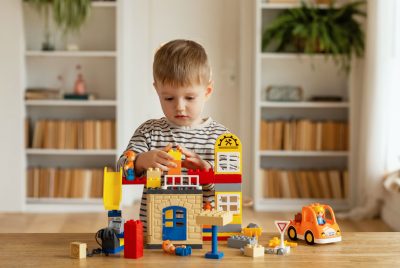
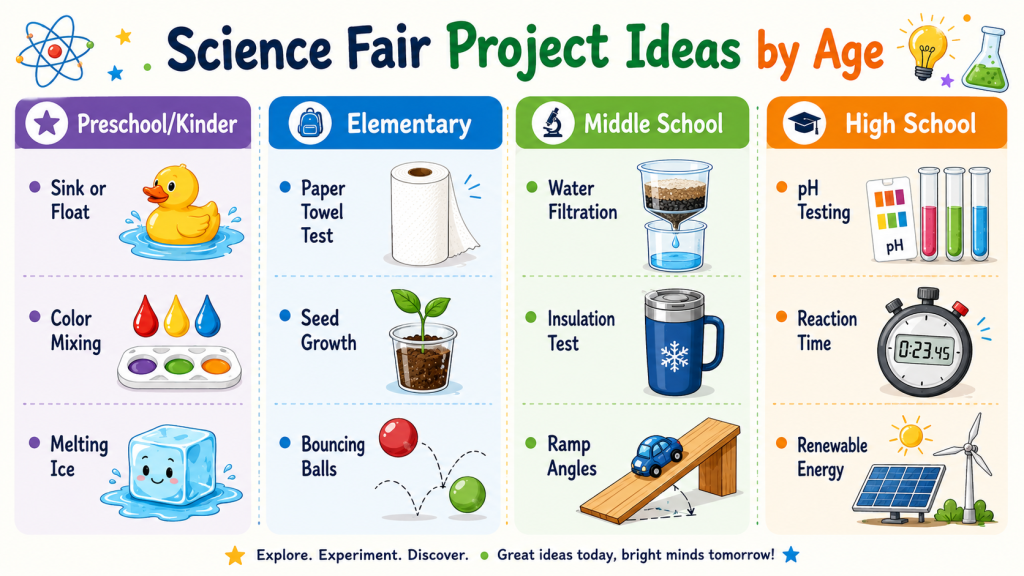
Easy Science Fair Project Ideas for Preschool and Kindergarten
Young children learn best through touching, pouring, sorting, and noticing. Keep the experiment short and visual.
Simple ideas for little learners
Try these easy science experiments:
- Which objects sink or float?
- What melts ice the fastest: salt, sugar, or warm water?
- Which fruit has the most seeds?
- What happens when you mix colors?
- Which surface makes a toy car roll farther?
For preschoolers, the goal is not a perfect hypothesis. The goal is curiosity. Let them guess, test, and explain in their own words.
You might hear, “The rock sank because it wanted to.” That is not textbook science, but it is a beautiful start.
Elementary Science Fair Project Ideas Kids Can Actually Do
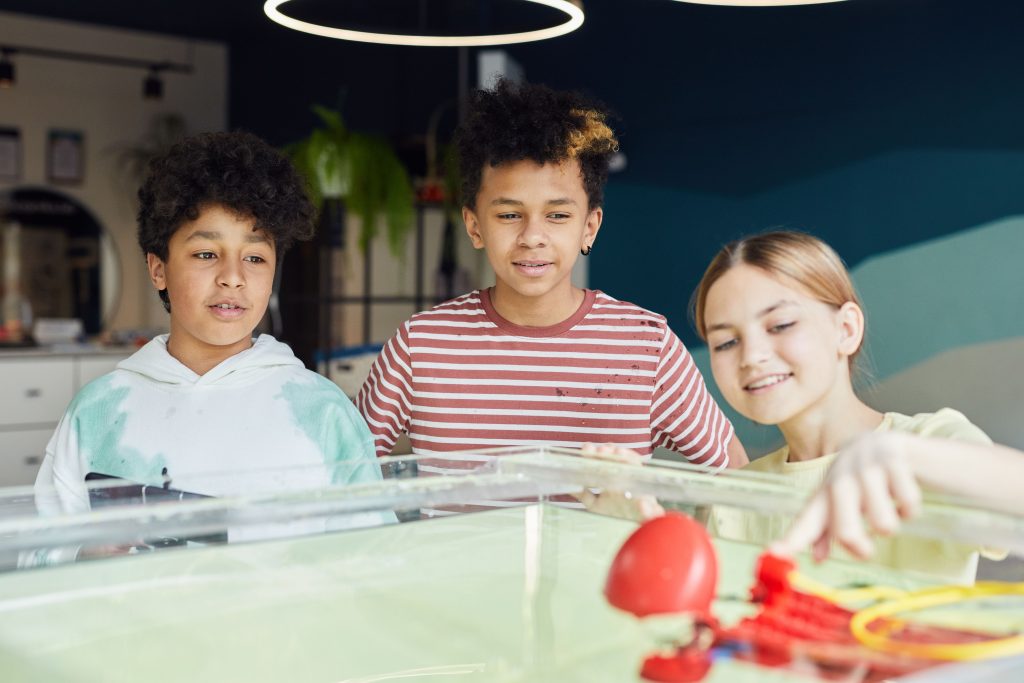
Elementary students can handle more structure. They can form a hypothesis, collect experiment results, and make simple charts.
Fun project ideas for grades 1–5
Consider these science project ideas:
- Which brand of paper towel absorbs the most water?
- Does music affect plant growth?
- Which liquid cleans pennies best?
- Which ball bounces the highest?
- Do different soils affect how fast seeds grow?
- Which type of cup keeps water cold longest?
- What kind of bridge design holds the most weight?
These projects work well because children can see clear results. They also use common materials, which is wonderful because not every family wants a science fair budget that rivals a vacation.
Middle School Science Fair Project Ideas With More Depth
Middle school students can explore variables more carefully. They can test patterns, explain data, and connect results to real-world problems.
Strong ideas for grades 6–8
Try these STEM activities:
- How does light color affect plant growth?
- Which natural material filters water best?
- Does temperature affect how fast yeast rises?
- Which material insulates heat best?
- How does screen brightness affect battery life?
- Which homemade solution removes stains most effectively?
- Does the angle of a ramp affect speed?
Encourage your child to choose one independent variable. For example, if they test plant growth, change only the light color, not the water, soil, pot size, and window location all at once. Science likes curiosity, but it also likes boundaries.
High School Science Fair Project Ideas for Older Students
High school students can handle more advanced research, but the project still needs to be manageable.
Ideas for teens
Here are a few stronger project directions:
- Compare biodegradable materials and decomposition rates.
- Test how pH affects enzyme activity.
- Study how different exercise types affect heart rate recovery.
- Build a simple water filtration prototype.
- Analyze how caffeine affects reaction time.
- Test renewable energy concepts with a small solar setup.
- Investigate how surface texture affects bacterial growth using safe methods.
For older students, the best Science Fair Project usually connects to a real issue: health, environment, technology, food, energy, or community life.
The Simple Scientific Method Kids Can Actually Use
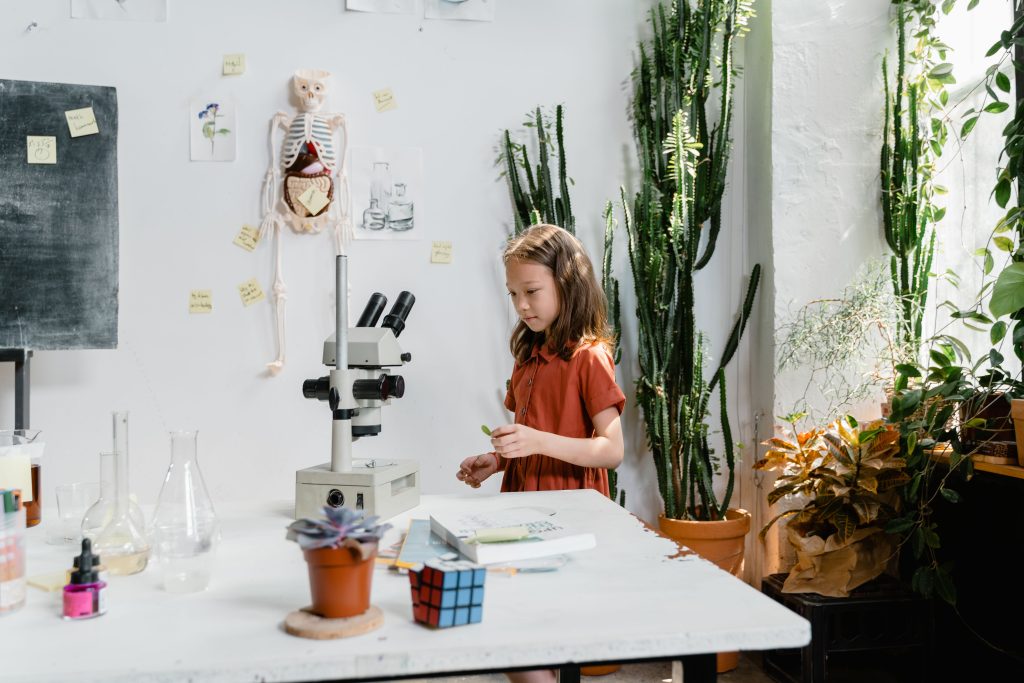
The scientific method can sound formal, but it is really a thinking path.
A kid-friendly version
Use this simple flow:
- Ask a question.
- Make a hypothesis.
- Plan the experiment.
- Test it fairly.
- Record the data.
- Explain the results.
- Share what you learned.
A hypothesis does not need to sound fancy. “I think the paper towel with thicker layers will hold more water” is enough.
Also, remind your child that a hypothesis can be wrong. Wrong does not mean failed. It means the experiment answered the question honestly.
How Parents Can Help Without Taking Over
This is the tricky parenting part. You want to help, but you do not want to accidentally become the unpaid project manager, lead scientist, graphic designer, and emotional support llama.
Your job is to guide, not rescue.
Helpful parent roles
You can:
- Help your child choose a safe topic.
- Gather materials.
- Ask guiding questions.
- Help manage the calendar.
- Supervise messy or risky steps.
- Encourage breaks when frustration shows up.
Try asking, “What do you think we should test next?” instead of saying, “Do it this way.” That small shift keeps ownership with your child.
If you have a baby or toddler in the house too, protect nap time like it is a national treasure. A calm home routine helps older kids focus, and if sleep setup is on your mind, this guide to choosing the best crib mattress for safe and comfortable baby sleep can help.
Recommended Products for Science Fair Projects
The right supplies can make a Science Fair Project easier, especially when you are short on time. These products are useful for experiments, displays, or beginner-friendly STEM exploration.
1. Learning Resources Primary Science Lab Set
Short description: A kid-friendly science tool set with lab-style pieces for younger children.
Features:
- Includes basic experiment tools
- Designed for small hands
- Encourages observation and pretend lab play
- Works well for early STEM activities
Use cases: Best for preschoolers, kindergarteners, and early elementary kids who need safe, simple tools for pouring, measuring, and observing.
2. NATIONAL GEOGRAPHIC Science Magic Kit
Short description: A science kit that blends experiments with magic-style demonstrations.
Features:
- Includes 100+ experiment and magic activity ideas
- Good for chemistry-style demonstrations
- Engaging for kids who love performance
- Helpful for sparking curiosity
Use cases: Great for elementary students who need a fun entry point into science and enjoy showing results to family or classmates.
3. 4M Crystal Growing Experiment
Short description: A crystal-growing kit that lets kids observe formation and growth over time.
Features:
- Includes multiple crystal-growing experiments
- Offers visual results
- Encourages patience and observation
- Works well for geology or chemistry themes
Use cases: Ideal for kids who enjoy pretty, display-worthy projects and can wait several days for results.
4. NATIONAL GEOGRAPHIC Mega Science Lab
Short description: A larger experiment kit with earth science, chemistry, and STEM project activities.
Features:
- Includes many experiment options
- Covers multiple science topics
- Useful for families with more than one child
- Good for brainstorming science fair ideas
Use cases: Best for parents who want one kit with several possible project directions.
5. Somime 12 Pack Trifold Poster Board, 36×48 Inches White Presentation Board
Short description: A large tri-fold board option for science fair displays.
Features:
- Standard presentation board size
- White surface for charts and photos
- Useful for school projects and displays
- Comes in a multi-pack
Use cases: Helpful for families with multiple children, classroom use, homeschool groups, or kids who want a clean project display board.
Research-Backed Benefits of Hands-On Science
Science fairs work best when kids do the thinking, testing, and explaining themselves.
A 2012 National Research Council framework emphasized that strong K–12 science learning should include practices like asking questions, planning investigations, analyzing data, and constructing explanations. That is exactly what a thoughtful Science Fair Project can help children practice through real activity, not just memorization. You can read more in the K–12 science education framework.
A 2014 expert review in the International Journal of STEM Education also highlighted planning and carrying out investigations as a key entry point for science learning and teacher development around NGSS science and engineering practices. In plain parent language: kids learn science more deeply when they actually do science. Here is the full review on planning and carrying out investigations in STEM education.
How to Build a Science Fair Project Display Board
The display board should tell the story of the experiment at a glance. Think of it like a museum exhibit, not a scrapbook explosion.
What to include
A strong board usually has:
- Title
- Question
- Hypothesis
- Materials
- Procedure
- Data or charts
- Photos
- Results
- Conclusion
Keep the layout clean. Use large headings. Leave white space. Your child does not need glitter on every corner unless glitter is somehow the dependent variable.
Common Science Fair Project Mistakes to Avoid
Most science fair stress comes from choosing something too big, too late, or too vague.
Watch out for these
Avoid:
- Picking a project with no measurable result
- Changing too many variables at once
- Waiting until the night before
- Letting the parent do most of the work
- Making the display board too crowded
- Forgetting to take photos during the experiment
- Using unsafe materials without supervision
A simple, well-explained project usually beats a complicated project nobody understands.
A Simple Timeline for Busy Families
A timeline keeps the project from eating your whole week.
Easy planning schedule
Two to three weeks before: Choose the topic and gather materials.
One to two weeks before: Run the experiment and record data.
Three to five days before: Make charts, write the conclusion, and print photos.
One to two days before: Assemble the board and practice the short presentation.
If you are starting late, choose a one-day experiment. No shame. Parenting is basically adapting with snacks.
FAQs About Science Fair Project Planning
What is the easiest Science Fair Project for kids?
The easiest Science Fair Project is one with simple materials and clear results. Good examples include testing which paper towel absorbs the most water, which liquid cleans pennies best, or which objects sink or float. These projects are easy to set up, measure, and explain.
How do I help my child choose a science fair idea?
Start with your child’s interests, then narrow the topic into a testable question. For example, if your child loves soccer, they might test which ball surface rolls farthest. If they love plants, they might test how light affects growth.
How long should a kids science project take?
It depends on the topic. Quick experiments can take one afternoon, while plant, crystal, or weather projects may need one to three weeks. Always check the due date before choosing the project so your child has enough time to collect useful results.
What should be on a science fair display board?
A science fair display board should include the title, question, hypothesis, materials, procedure, data, results, photos, and conclusion. Keep it organized so judges, teachers, and classmates can understand the project quickly.
Can a science fair experiment fail?
Yes, and that is completely okay. An experiment that does not match the hypothesis can still be successful if your child records what happened, explains the results, and reflects on what they would change next time.
Final Thoughts on Making Science Fair Less Stressful
A Science Fair Project does not need to turn your home into a dramatic laboratory sitcom. Keep it simple, let your child lead, and focus on learning instead of perfection. The best project is one your child understands and can proudly explain in their own words. Whether they grow crystals, test paper towels, build a ramp, or compare plant growth, they are practicing curiosity, patience, and problem-solving. Those skills last much longer than a ribbon. So take a breath, clear a little table space, and help your young scientist begin.