
Best Organic Diapers for Newborns and Toddlers
We may earn a commission for purchases made using our links. Please see our disclosure to learn more.
There is nothing quite like changing your baby at 2 a.m., fastening a fresh diaper, and discovering ten minutes later that it has leaked through the pajamas, sleep sack, and crib sheet. At that hour, even the sweetest woodland print cannot save a disappointing diaper.
Organic diapers appeal to parents who want softer materials, fewer unnecessary additives, and more thoughtful environmental practices. However, the labels can be confusing. “Natural,” “clean,” “plant-based,” and “eco-friendly” may sound similar, but they do not always mean the same thing.
This guide explains what to look for, which features genuinely matter, and how five popular Amazon options compare for newborns, toddlers, sensitive skin, and everyday family life.
What Are Organic Diapers?
The phrase organic diapers usually describes disposable diapers containing organic cotton, plant-derived fibers, bamboo viscose, or sustainably sourced wood pulp.
However, most disposable diapers are not made entirely from organic materials. They still need elastic, adhesives, waterproof layers, and superabsorbent polymers to control wetness.
Therefore, think of “organic” as a product category rather than a universal certification. The real value sits in the material list, testing standards, and manufacturing details—not simply the word printed across the box.
Why Parents Choose Organic Diapers
Parents often explore organic diapers because they want materials that feel gentler against delicate skin. Others hope to avoid fragrance, lotions, latex, dyes, or chlorine bleaching.
Environmental concerns also matter. You may prefer diapers made with FSC-certified pulp, renewable materials, recyclable packaging, or independently verified manufacturing practices.
Still, practicality counts. A diaper can have impressive green credentials, but if it leaks during every car ride, the relationship may be brief.
What the Organic Label Really Means
There is no single US standard that makes an entire disposable diaper “certified organic.” A diaper may contain certified organic cotton while its absorbent core, tabs, and waterproof backing remain synthetic.
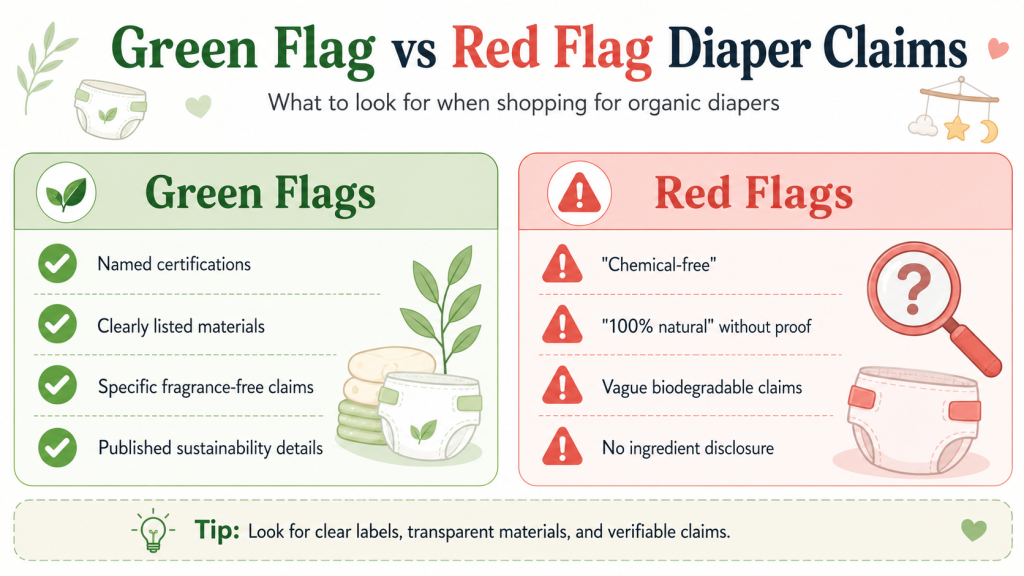
Look for specific, verifiable statements such as:
- Organic cotton in the liner or outer cover
- Totally Chlorine Free, commonly shortened to TCF
- FSC-certified wood pulp
- OEKO-TEX Standard 100 certification
- Nordic Swan or similar environmental certification
- Clear fragrance-, lotion-, dye-, and latex-free claims
Be cautious with vague promises such as “chemical-free.” Everything is made of chemicals—including water. Clear ingredient disclosures are far more useful than dramatic packaging language.
Organic Diapers vs Regular Diapers
Conventional and organic diapers use similar basic engineering. Both typically include a soft top sheet, an absorbent core, leak guards, elastic leg openings, and a water-resistant outer layer.
The main differences usually involve the materials touching your baby’s skin, bleaching methods, fragrance, sourcing, and environmental certifications.
Organic diapers are not automatically more absorbent or better at preventing rashes. Fit, breathability, frequent changes, and moisture control still play leading roles. A well-fitting conventional diaper may outperform an expensive plant-based diaper that gaps around your baby’s legs.
Features That Matter Most
Before buying a full monthly box, compare these practical features:
- Absorbency: Moisture should move away from the skin quickly.
- Fit: Stretchy waistbands and flexible leg cuffs help contain leaks.
- Softness: Rough seams or stiff materials can create friction.
- Wetness indicator: Especially helpful during the newborn stage.
- Ingredient disclosure: Brands should explain what is included and excluded.
- Available sizes: Make sure the range continues into toddler sizes.
- Price per diaper: Package prices can be misleading when quantities differ.
Start with a smaller pack. Babies are wonderfully committed to having their own opinions, especially about products bought in bulk.
Best Organic Diapers on Amazon
The following products appear in organic, natural, or plant-based diaper searches on Amazon. Not every option is completely organic, so the descriptions distinguish verified features from broader marketing language.
1. Pura Hypoallergenic Diapers
Pura Hypoallergenic Diapers are made with soft organic cotton comfort and plant-based materials against the baby’s skin. The diapers are Totally Chlorine Free and made without fragrance, lotion, parabens, phthalates, or natural rubber latex.
Features: Wetness indicator, flexible fit, organic cotton, TCF construction.
Best for: Families wanting an organic cotton diaper with newborn and toddler sizing.
2. DYPER Viscose From Bamboo Baby Diapers
DYPER Baby Diapers use a bamboo-viscose liner designed to feel soft and wick moisture away from the skin. The Amazon listing describes them as plant-based, hypoallergenic, and free from perfume, lotions, phthalates, parabens, and several other commonly avoided additives.
Features: Bamboo-viscose liner, wetness indicator, stretchy waistband.
Best for: Babies whose parents prioritize softness and plant-derived materials.
3. Bambo Nature Premium Baby Diapers
Bambo Nature Premium Baby Diapers combine a three-layer design, absorbent core, wetness indicator, and eco-focused certifications. Amazon identifies options in the range as OEKO-TEX Standard 100 certified, while the brand emphasizes fragrance-free and lotion-free construction.
Features: Wetness indicator, breathable design, independent certifications.
Best for: Certification-minded families and babies with fragrance sensitivities.
4. Naty Bamboo Viscose Baby Diapers
Naty Bamboo Viscose Baby Diapers use FSC-certified bamboo viscose and pulp. According to the Amazon listing, they are OEKO-TEX Standard 100 certified and made without fragrance, lotion, latex, chlorine, phthalates, or dyes.
Features: Bamboo-viscose materials, wide fit, elastic waist and leg cuffs.
Best for: Parents looking for a fragrance-free bamboo diaper with broad sizing.
5. The Honest Company Clean Conscious Diapers
The Honest Company Clean Conscious Diapers are widely available and come in multiple sizes and prints. Although they are better described as plant-based or clean-conscious diapers than fully organic diapers, they remain a convenient option for parents comparing mainstream alternatives.
Features: Plant-based materials, flexible fit, multiple sizes and designs.
Best for: Families wanting an accessible option that is easy to reorder or find locally.
Choosing Diapers for Newborns
Newborns need softness, reliable leak guards, and a secure fit around very small legs. A wetness indicator can also spare you from performing the midnight “sniff test,” a parenting skill nobody adds to a résumé.
Avoid stocking too many newborn-size diapers before birth. Some babies outgrow them quickly, while others need that size for several weeks.
A diaper with an umbilical-friendly shape or a front panel that folds down may also be helpful until the cord stump heals.
Choosing Diapers for Active Toddlers
Toddlers twist, climb, squat, sprint away mid-change, and occasionally behave as though pants are an unreasonable social expectation. Their diapers need flexible sides and a waistband that stays secure during movement.
Check that the product offers larger sizes with strong leg cuffs. Overnight absorbency may also become more important as your child sleeps longer.
Once everyone is clean and dressed, these easy games to play with friends and family can help channel some of that legendary toddler energy.
Organic Diapers and Sensitive Skin
Fragrance-free and lotion-free diapers may be useful when a baby reacts to scented products. However, no diaper can guarantee freedom from irritation.
Moisture, friction, stool enzymes, diarrhea, antibiotics, and infrequent changes can all contribute to diaper dermatitis. The American Academy of Pediatrics advises changing wet or soiled diapers frequently, cleaning gently, and allowing the skin to dry before fastening a fresh diaper.
Introduce one new diaper brand at a time. That makes it easier to identify the cause if redness appears.
What Research Says About Diaper Rash
A 2025 systematic review of diaper dermatitis prevention and treatment examined 13 studies involving 2,935 children. The researchers identified moisture, friction, elevated skin pH, and prolonged contact with urine and stool as major contributors to irritation.
Meanwhile, a 2018 clinical study comparing newer diaper materials found that diaper construction and moisture-management technology could influence rash outcomes. Earlier clinical research also associated highly absorbent diaper cores with lower rates of diaper dermatitis than older conventional designs.
The practical lesson is simple: materials matter, but dryness and fit may matter even more.
How to Get the Right Fit
Use your baby’s weight as a starting point, then watch how the diaper behaves.
A good fit should:
- Sit just below the belly button
- Allow two fingers beneath the waistband
- Cover the bottom completely
- Keep the leg ruffles turned outward
- Leave no deep marks on the waist or thighs
Frequent blowouts may mean the diaper is too small. Gaps around the legs may indicate that it is too large or shaped poorly for your baby.
How to Budget Without Overspending
Organic diapers often cost more per change, so compare the price per diaper rather than the package price.
Subscriptions can reduce costs, but test one or two small packs first. Buying 180 diapers that do not fit is less of a bargain and more of a very bulky lesson.
You can also use premium diapers selectively. Some families choose them overnight or during rash-prone periods while using a more affordable fragrance-free option during the day.
Is it more environmentally friendly to use organic diapers?
Plant-derived materials and responsible pulp sourcing can reduce reliance on some petroleum-based inputs. Even so, most disposable diapers contain mixed materials and are not suitable for ordinary home composting.
Do not treat “biodegradable” as meaning that a used diaper can go into your garden compost. The Federal Trade Commission requires environmental claims such as biodegradable or compostable to be properly supported and clearly qualified. It has previously challenged misleading compostability claims involving diapers.
Choose brands that publish specific sourcing, packaging, and manufacturing information rather than broad green promises.
Frequently Asked Questions
Are organic diapers safer for newborns?
They may reduce exposure to fragrance, lotion, or certain dyes, depending on the product. However, “organic” alone does not prove that a diaper is safer. Review its materials, certifications, absorbency, and fit.
Do organic diapers prevent diaper rash?
Not necessarily. Frequent changes, gentle cleaning, effective moisture control, breathable materials, and a proper fit usually matter more than the label on the package.
Are bamboo diapers actually organic?
Bamboo is a plant, but bamboo viscose undergoes substantial processing. A bamboo diaper should not be described as organic unless the relevant material has a recognized organic certification.
How often should a newborn diaper be changed?
Change a newborn promptly after bowel movements and whenever the diaper is wet or uncomfortable. Frequent changes limit prolonged contact with moisture and irritants.
Can organic disposable diapers be composted?
Usually not through home composting. Mixed materials, absorbent polymers, and human waste create practical and sanitation limitations. Follow the manufacturer’s disposal instructions and local waste rules.
Final Thoughts on Choosing Organic Diapers
The best organic diapers are not necessarily the ones with the greenest packaging or the longest “free-from” list. They are the diapers that fit your child comfortably, manage moisture, disclose their materials, and work within your family’s budget.
Test small packs, observe your baby’s skin, and give yourself permission to change brands. Parenting already comes with enough pressure. Your diaper choice does not need to become a personality test.