Easy Plant Cell Project Ideas Kids Can Make at Home
We may earn a commission for purchases made using our links. Please see our disclosure to learn more.
If you have ever heard, “I need a plant cell project by tomorrow,” you already know the panic. Suddenly you are staring at craft supplies, a school rubric, and a child who is either wildly excited or deeply offended by glue.
The good news is that a Plant Cell Project does not have to be fancy to be effective. It just needs to help your child understand the main plant cell parts, label them clearly, and present the idea in a way they can explain with confidence. That is the real win.
In this guide, you will find easy project styles, simple supply ideas, age-appropriate tips, a few sanity-saving shortcuts, and product suggestions that can make the whole thing smoother.
This article includes product suggestions for convenience. I may earn a small commission if you choose to buy through linked products, at no extra cost to you.
Why a Plant Cell Project Can Feel Weirdly Stressful
A school project sounds simple until real life shows up. Maybe you are short on time. Maybe your child hates messy crafts. Maybe you are trying to help without quietly taking over the whole project yourself.
That’s the point where a lot of parents hit a wall.
A Plant Cell Project sits in that awkward middle zone. It is academic, but it is also creative. Kids need to understand plant cell parts like the nucleus, chloroplasts, vacuole, and cell wall, but they also need to turn those words into something visible. That is where the pressure sneaks in.
Still, this is one of those assignments that can actually feel fun once you choose the right format.
What Kids Really Need to Show in a Plant Cell Project
Before you buy anything, pause and ask one question: what does the teacher actually want?
In most cases, your child does not need museum-quality biology art. They usually need these basics:
- a clear plant cell shape
- labeled organelles
- correct placement of the main parts
- a simple explanation of what each part does
That means a plant cell model for school can be made from clay, cardboard, food, paper, or recycled materials. The format matters less than the accuracy and clarity.
Pick the Right Plant Cell Project for Your Child
This part changes everything.
A crafty child may love a 3D plant cell model with clay and paint. A child who dislikes sticky hands may do better with a poster or shoebox scene. A child who loves snacks may suddenly become very invested in an edible plant cell model. Funny how that works.
Think about your child’s personality first.
If your child is:
- visual, choose a color-coded poster
- hands-on, choose clay or foam
- short on patience, choose a shoebox or tray model
- food-motivated, choose the edible version
The best science fair project is the one your child can actually finish without a meltdown at 9:47 p.m.
Easy Supplies to Gather Before You Start
You do not need a giant craft haul. Start with what you already have.
Good basics include:
- cardboard, poster board, or a shallow box
- glue
- markers or paint
- clay, foam, or paper scraps
- toothpicks or label flags
- printed notes or index cards for labels
You can also use items from your own kitchen or craft bin. Dry beans, lentils, rice, yarn, felt, buttons, and cotton balls all work beautifully. In some homes, that might mean black beans and rice. In others, it might mean split peas, chickpeas, or fabric scraps from an old sewing box. That kind of flexibility makes the project feel more personal and less like a one-size-fits-all Pinterest challenge.
And if your child already enjoys colorful hands-on crafts, they may also love these simple decorate Easter eggs ideas for kids, which use the same playful mix of color, texture, and creativity.
Plant Cell Parts Kids Should Label Clearly
A strong plant cell diagram does not need every tiny detail. It does need the major structures.
Here are the parts most kids should include:
- Cell wall: the firm outer layer that gives the plant cell shape
- Cell membrane: the layer just inside the wall that controls what enters and leaves
- Cytoplasm: the jelly-like material that holds everything in place
- Nucleus: the control center
- Chloroplasts: the parts that help plants make food from sunlight
- Central vacuole: the large storage sac that helps the cell stay firm
A simple way to explain this to kids is to compare the cell to a house. The cell wall and cell membrane are like the outside structure and door. The nucleus is the manager. The cytoplasm is the living space. The vacuole is the storage room. Chloroplasts are the solar panels.
How to Make a 3D Plant Cell Project With Clay
This is one of the easiest and most impressive options.
Step 1: Make the base
Shape a rectangle or oval from clay, foam, or a cut foam ball half. Plant cells are usually shown with a boxier outline than animal cells.
Step 2: Add the main organelles
Use different clay colors for the nucleus, chloroplasts, vacuole, and cytoplasm. Keep the large central vacuole obvious, since that is one of the big features that makes a plant cell different.
Step 3: Label everything
Stick small paper flags into the model or place labels around the base.
This version works especially well for kids who learn by building. It turns abstract vocabulary into something they can literally hold.
How to Make a Shoebox Plant Cell Project
A shoebox version is great when your child wants a structured, less messy biology project for kids.
Paint or color the inside of the box as the cell interior. Then glue on cut-out organelles using paper, felt, foam, or clay pieces. Use the box edges to represent the cell wall, and add an inner outline for the membrane.
The nice part about this version is that it keeps everything contained. Less rolling clay. Less disappearing labels. Less mystery glue on the dining table.
How to Make an Edible Plant Cell Project
This one is always a hit, but check school allergy rules first.
Use a cake, brownie pan, gelatin tray, or cookie base for the cell body. Then use candy or fruit for the organelles. For example, one large gummy shape can stand in for the vacuole, and green candies can represent chloroplasts.
This type of Plant Cell Project is memorable because kids connect the parts with color, shape, and taste. Just make sure they label it clearly before anyone starts “studying” by eating the chloroplasts.
How to Make a Poster-Style Plant Cell Project
Not every project has to be 3D.
A poster is ideal for kids who prefer drawing, writing, and organizing information neatly. Draw a large plant cell in the center, then label each organelle with arrows. Around the edges, add short descriptions of what each part does.
This is also the easiest option for older kids who want the project to look clean and academic rather than crafty.
Color and Label Tricks That Help Kids Remember
A Plant Cell Project becomes much easier to explain when the colors have a purpose.
Try this:
- green for chloroplasts
- blue for vacuole
- purple for nucleus
- yellow or clear area for cytoplasm
- dark outline for cell wall
- lighter inner outline for membrane
Then keep labels short.
Instead of writing a paragraph on the display, write one clean line:
- “Nucleus: controls the cell”
- “Chloroplast: helps make food”
- “Vacuole: stores water and keeps shape”
Short labels help kids present without sounding like they memorized a textbook against their will.
A Simple One-Night Plan for Busy Parents
If you only have one evening, do not overcomplicate it.
Here is a realistic plan:
First 15 minutes
Choose the format and gather supplies.
Next 25 minutes
Build the base and place the major organelles.
Next 20 minutes
Add labels and check spelling.
Final 10 minutes
Let your child practice explaining three big ideas:
- what makes it a plant cell
- what the nucleus does
- why chloroplasts matter
That is enough for a solid homeschool science activity or school assignment. Done is better than overdesigned.
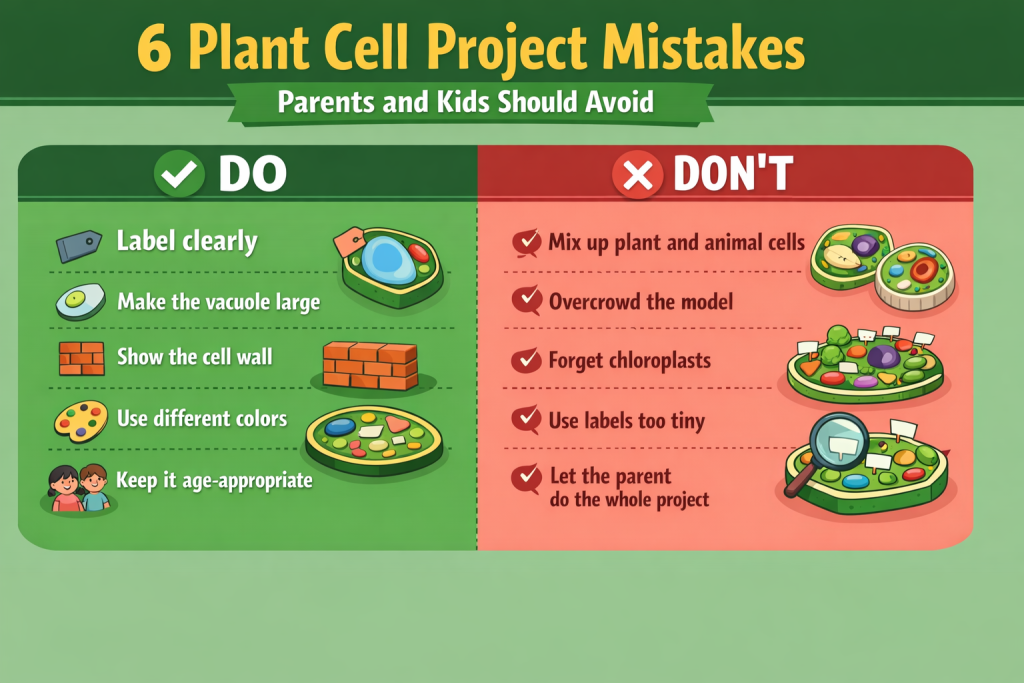
Common Plant Cell Project Mistakes to Avoid
Most mistakes are small, but they can make the project confusing.
Watch out for these:
- mixing up plant cells and animal cells
- forgetting the cell wall
- making the vacuole too small
- using too many tiny labels
- choosing a design that is too hard for your child’s age
- letting the parent do all the work
That last one is the sneaky one.
Teachers can usually tell when a project looks like it was completed by a sleep-deprived adult with strong opinions about symmetry. Let your child’s effort show. A slightly lopsided chloroplast is still a win.
Recommended Supplies That Make a Plant Cell Project Easier
Here are five helpful products that can make a Plant Cell Project faster, cleaner, and easier to finish.
1) Juvale 3-Inch Foam Balls for Crafts
Short description: A simple base for a rounded 3D cell model.
Features: Smooth foam surface, lightweight build, and easy-to-cut material.
Use case: Best for kids making a 3D plant cell model who want a base they can paint or slice in half.
2) MuseLuxe Air Dry Clay – 32 Colors Modeling Clay Kit with 3 Sculpting Tools
Short description: A colorful clay kit that makes organelles easy to shape.
Features: 32 colors, sculpting tools, non-toxic material, and air-dry convenience.
Use case: Great for younger kids or families who want bright organelles without needing to paint everything afterward.
3) Elmer’s E301 School Glue, Washable No-Run, 1.25 Ounces (Pack of 12)
Short description: Reliable glue for paper, foam, and lightweight craft pieces.
Features: No-run formula, fast clear drying, washable, and non-toxic.
Use case: Best for parents who want fewer drips and less mess during a last-minute plant cell model for school build.
4) Crayola Washable Kids’ Paint, Assorted Colors 10 ea, 6 Pack
Short description: A washable paint option for posters, foam, and cardboard models.
Features: Assorted colors and a kid-friendly washable formula.
Use case: Helpful for families doing a poster, shoebox, or painted foam version of a Plant Cell Project.
5) LonlyEagle 36” x 48” Trifold Poster Board, White Corrugated Project Boards for Presentations, Science Fair, School Projects, Event Displays and Trifold Picture Board, 2 Pack
Short description: A sturdy presentation board for clean final display.
Features: Large 36 x 48 size, trifold layout, and compatibility with markers, paint, and glue.
Use case: Best for older kids or anyone turning a plant cell diagram into a polished presentation board.
What Research Says About Hands-On STEM at Home
There is a reason these projects stick with kids.
The American Academy of Pediatrics’ Power of Play overview explains that play supports cognitive growth and helps build motor competence, including fine motor skills. That matters because a Plant Cell Project asks kids to cut, place, sort, compare, label, and explain, all in one activity. In plain English, it is science learning disguised as glue and colored blobs.
A 2022 home STEM study on parent-child interaction looked at 81 children ages 4 to 7 and their caregivers during a hands-on activity at home. The researchers examined how adult-child interaction shaped the learning experience. That is a useful reminder for parents: your job is not to build the model perfectly. Your real value is in asking questions, encouraging ideas, and helping your child talk through what they are making.
Plant Cell Project FAQs
What is the easiest Plant Cell Project for kids?
A poster or shoebox version is usually the easiest. It keeps the project organized, uses simple supplies, and still lets kids show all the major organelles clearly.
How do you make a Plant Cell Project with household items?
Use cardboard, beans, rice, yarn, paper scraps, bottle caps, or clay you already have. The key is labeling the parts correctly, not buying fancy supplies.
What organelles should be included in a Plant Cell Project?
Most school projects should include the cell wall, cell membrane, cytoplasm, nucleus, chloroplasts, and central vacuole. Those are the big ones teachers usually expect.
What is the difference between a plant cell and an animal cell project?
A plant cell project should show a cell wall, chloroplasts, and one large central vacuole. Those features help separate it from an animal cell model.
How can I support my child with the project without doing it for them?
Let your child choose colors, place parts, and explain the labels. You can help with setup, cutting, spelling, and time management, but the ideas should still feel like theirs.