
Tips for New Parents: Practical Advice That Helps

We may earn a commission for purchases made using our links. Please see our disclosure to learn more.
Bringing home a baby can feel like being handed the world’s sweetest little mystery box—with no instruction manual, very little sleep, and somehow fourteen opinions about burping.
These tips for new parents are here to make the early days feel less overwhelming and more doable. You’ll learn how to handle newborn care, sleep, feeding, baby safety, routines, emotional ups and downs, and the tiny everyday decisions that suddenly feel huge.
This article includes affiliate product suggestions. If you buy through qualifying links, the site may earn a small commission at no extra cost to you.
Start With “Good Enough,” Not Perfect
New parenthood has a sneaky way of making you think every choice is a final exam. It is not.
Your baby does not need perfect parents. Your baby needs responsive, loving, reasonably rested humans who keep showing up.
Some days, success looks like tummy time, a clean kitchen, and a peaceful nap. Other days, success looks like everyone fed, everyone safe, and you remembering where you put your coffee.
A helpful reset
Ask yourself: “Is my baby safe, loved, fed, and cared for?” If yes, you are already doing the big things right.
Build a Simple Newborn Care Rhythm
One of the best tips for new parents is to stop chasing a perfect schedule too early. Newborns are wonderfully tiny, but they are not exactly calendar people.
Instead, think in rhythms:
- Feed
- Diaper
- Cuddle
- Sleep
- Repeat, with surprises
A rhythm gives your day a gentle shape without making you feel like you failed because the baby napped at 10:17 instead of 10:00.
Keep a loose log
For the first few weeks, track feeds, wet diapers, dirty diapers, and sleep. Not forever—just long enough to notice patterns and answer your pediatrician’s questions with something better than “Umm… Tuesday?”
Make Sleep Safer Before You Make It Longer
Every new parent wants better sleep. Fair. Sleep becomes a mythical creature when there is a newborn in the house.
But before worrying about long stretches, focus on safe sleep.
The American Academy of Pediatrics’ 2022 safe sleep guidance recommends placing babies on their backs on a firm, flat, non-inclined sleep surface, without soft bedding or loose objects.
Baby sleep routine basics
A simple baby sleep routine may include:
- Dim lights
- Fresh diaper
- Feeding
- Short song or quiet cuddle
- Baby placed on their back in a safe sleep space
It does not need to be fancy. Babies are not judging your nursery aesthetic.

Feed Your Baby Without Turning It Into a Report Card
Newborn feeding can bring up a lot of emotion, especially for first-time parents. Breastfeeding, formula feeding, combo feeding—families arrive at feeding in different ways.
The objective is for a well-nourished infant and a nurturing parent.
The CDC’s 2024 newborn breastfeeding guidance notes that many breastfed newborns feed about 8–12 times in 24 hours, especially in the early weeks. That can feel like a lot because, well, it is.
Watch the baby, not just the clock
Look for signs like swallowing, relaxed hands after feeding, steady weight gain, and enough wet and dirty diapers. If something feels off, call your pediatrician or a lactation consultant.
Learn Your Baby’s Cues
Babies communicate before they talk. They stretch, root, grimace, turn away, stare, wiggle, cry, and sometimes make faces that look deeply unimpressed.
Learning cues is one of the most underrated newborn care tips.
Common newborn cues
Hunger cues may include rooting, sucking hands, or turning toward your chest. Tired cues may include yawning, red eyebrows, fussiness, or looking away.
Crying is often a late cue. That does not mean you missed everything. It just means your tiny roommate has upgraded the notification setting.
Create Tiny Routines That Calm Everyone
Routines are not about controlling the baby. They are about helping everyone know what comes next.
A bedtime routine, morning routine, or diaper-change routine can become a little island of predictability.
Try a three-step routine
For example:
- Change diaper
- Sing the same short song
- Cuddle for one minute
That is enough. Small rituals tell your baby, “You are safe. We do this together.”
Share the Load Before You Feel Burned Out
Many parents wait until they are completely drained before asking for help. Try not to make exhaustion the entrance fee.
If you have a partner, talk early about nights, meals, laundry, appointments, and mental load. If you are parenting solo, build a small circle where possible: relatives, friends, neighbors, faith community, parent groups, or postpartum support services.
A practical division
One person can handle feeding while another handles burping and diaper changes. One can take the first night shift, the other the early morning shift.
The point is not perfect fairness every hour. It is sustainable teamwork.

Keep Baby Safety Tips Simple
Baby safety can feel like a giant checklist, but start with the big rocks.
Use a properly installed car seat. Place baby on their back for sleep. Keep small objects, cords, hot drinks, and medications out of reach. Never shake a baby. Step away safely if you feel overwhelmed.
The “pause and place” rule
If crying pushes you to your limit, place your baby in a safe space, like a crib, and take a few minutes to breathe. A crying baby in a safe crib is safer than a caregiver at the breaking point.
Protect Your Mental Health Too
Postpartum support matters for every kind of parent. Moms, dads, adoptive parents, and non-birthing partners can all feel anxiety, sadness, irritability, or emotional whiplash.
You are not weak for seeking help. You are human.
Signs to take seriously
Reach out to a doctor or mental health professional if you feel hopeless, panicky, disconnected from your baby, unable to sleep even when the baby sleeps, or afraid you might hurt yourself or someone else.
Getting help early is a form of love.
Accept Help Without Guilt
When people say, “Let me know if you need anything,” give them a job.
Ask for dinner, grocery pickup, laundry help, dog walking, school drop-off for older kids, or a 30-minute baby hold while you shower.
Make help specific
Instead of saying, “We’re okay,” try:
- “Could you bring dinner Tuesday?”
- “Could you hold the baby while I nap?”
- “Could you pick up diapers?”
People often want to help. They merely need a door to walk through.
Be Careful With Advice Overload
New parents get advice from doctors, grandparents, friends, social media, strangers in checkout lines, and people who last held a baby in 1998.
Some advice is gold. Some is noise wearing a confident hat.
Use a simple filter
Ask:
- Is this advice safe?
- Is it from a reliable source?
- Does it fit my baby?
- Does it fit our family?
When in doubt, bring questions to your pediatrician. Your baby is a person, not a comment section.
Think Beyond the Baby Stage
It may feel impossible to imagine school projects when you are currently celebrating one decent burp. But parenting grows in layers.
Today, you are learning feeding cues. Later, you will be helping with friendships, homework, curiosity, and confidence. When that season comes, simple hands-on learning—like these hands-on science fair project ideas—can help your child explore the world with wonder.
The long view helps
You do not need to master every future stage now. Just remember: you and your child are both growing.
Research-Backed Tips for New Parents
Good parenting advice should feel supportive, but it should also be backed by trusted guidance.
The American Academy of Pediatrics recommends placing babies on their backs for sleep, using a firm and flat sleep surface, and keeping pillows, blankets, crib bumpers, and stuffed animals out of the crib. Their simple safe sleep guidance for newborns is one of the most important resources for new parents.
Feeding can also feel confusing in the early weeks. The CDC explains that newborns often feed frequently, especially breastfed babies, and cluster feeding can be normal. Their newborn feeding rhythm guide helps explain what to expect.
Helpful Products for New Parents
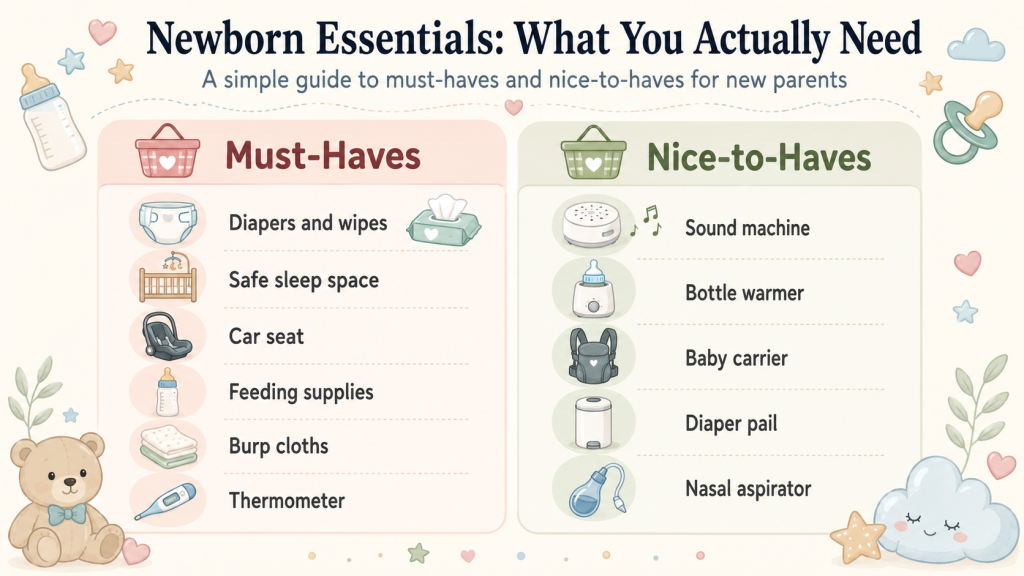
These newborn essentials are not magic wands, but they can make daily care smoother.
Hatch Baby Sound Machine, Night Light
The Hatch Baby Sound Machine, Night Light supports bedtime routines with white noise, soft light, and routine-building features.
Features: sound machine, night light, time-to-rise function, app-connected options.
Best for: parents building a calming baby sleep routine.
BabyBjörn Baby Carrier Mini
The BabyBjörn Baby Carrier Mini, Light Gray, 3D Jersey is designed for newborn closeness and short babywearing sessions.
Features: soft fabric, newborn-friendly design, ergonomic support, easy on and off.
Best for: parents who want hands free for snacks, laundry, or simply feeling human.
Philips Avent Premium Fast Bottle Warmer
The Philips Avent Premium Fast Bottle Warmer helps warm bottles with smart temperature control.
Features: water bath warming, automatic shut-off, compact design.
Best for: formula-feeding, pumping, or combo-feeding families.
Frida Baby NoseFrida SnotSucker
The Frida Baby NoseFrida SnotSucker helps clear stuffy noses gently.
Features: nasal suction design, disposable filters, no deep insertion into nostrils.
Best for: babies with congestion who struggle to feed or sleep comfortably.
Ubbi Stainless Steel Diaper Pail
The Ubbi Stainless Steel Diaper Pail helps contain diaper odor without requiring special bags.
Features: steel body, sliding lid, odor seal, child lock.
Best for: parents who want the nursery to smell less like “what happened in here?”
FAQs About Tips for New Parents
What are the best tips for new parents in the first month?
Focus on feeding, safe sleep, diaper output, bonding, and rest. Keep expectations low and support high. The first month is about recovery, learning your baby, and building confidence one small win at a time.
How do new parents survive sleep deprivation?
Sleep in shifts when possible, nap when help is available, simplify chores, and avoid late-night scrolling. If exhaustion feels unsafe, ask someone trusted to step in so you can rest.
What newborn essentials do first-time parents actually need?
Start with diapers, wipes, safe sleep space, car seat, feeding supplies, burp cloths, simple clothing, thermometer, and a few soothing tools. You can add extras later once you know your baby’s needs.
How can I bond with my baby if I feel overwhelmed?
Bonding can happen through feeding, diaper changes, skin-to-skin contact, soft talking, eye contact, and responding to cues. It does not always feel instant. Connection often grows through repeated small moments.
When should new parents contact the pediatrician?
Call for fever in a newborn, poor eating, fewer wet diapers, breathing problems, extreme tiredness, odd screaming, dehydration symptoms, or anything else that feels seriously wrong. Trust your instincts.
Conclusion
The best tips for new parents are usually the simple ones: keep your baby safe, feed them with care, learn their cues, accept help, protect your mental health, and give yourself room to grow.
You will not do everything perfectly. Nobody does. But every diaper changed, every sleepy cuddle, every “I’m not sure, but I’m trying” moment counts.
Parenting is not a performance. It is a relationship. Take it one day, one feed, one nap, one deep breath at a time.