Fun Games To Play With Friends
We may earn a commission for purchases made using our links. Please see our disclosure to learn more.
Some days, kids do not need another app, another video, or another “educational” thing disguised as homework with brighter colors. They need laughter. They need movement. They need that magical moment when one child says, “Wait, let’s play this again,” and suddenly the room feels lighter.
That is where Fun Games To Play With Friends can make a real difference.
Whether you are planning a playdate, birthday party, sleepover, classroom activity, or simple Saturday afternoon, the right game can turn awkward silence into giggles, teamwork, and memories. This guide will help you choose easy, screen-free, low-stress games kids can play with friends indoors, outdoors, in small groups, or with a whole wild bunch.
Why Friendship Games Matter More Than You Think
Games are not just “something to keep kids busy.” They are tiny social classrooms.
When kids play together, they practice taking turns, listening, handling disappointment, solving problems, and reading emotions. In other words, they learn the stuff adults still sometimes struggle with at family reunions.
The American Academy of Pediatrics notes that developmentally appropriate play with parents and peers supports social-emotional, cognitive, language, and self-regulation skills. Play also helps build executive function and healthy relationships.
So yes, when your child plays tag, charades, or a silly guessing game, they are not “just playing.” They are rehearsing life.
How To Choose Fun Games To Play With Friends
The best games are not always the fanciest ones. Often, the winner is the game that matches the mood.
Before choosing, ask:
- How many kids are playing?
- Are they shy, energetic, competitive, or mixed?
- Do you need indoor games for friends or outdoor games for kids?
- Are the ages close or very different?
- Do you want calm connection or full-body movement?
A good rule: choose games with simple instructions, quick rounds, and room for laughter. If you need a 12-minute explanation, the kids may emotionally leave the building by minute three.
Quick Icebreaker Games For Shy Kids
Icebreakers help kids warm up without feeling put on the spot.
Two Truths and One Silly Fib
Each child says two true things and one made-up thing. The group guesses the fib. Keep it light: favorite snacks, pets, funny habits, dream superpowers.
Name and Motion
One child says their name and does a movement. Everyone repeats it. It feels goofy at first, but that is the point. Awkwardness melts faster when everyone looks equally ridiculous.
Would You Rather?
Ask gentle questions like, “Would you rather have a pet dragon or a robot helper?” This works well for mixed personalities because kids can answer without performing.
Classic No-Supply Games Kids Still Love
Sometimes the best Fun Games To Play With Friends require absolutely nothing.
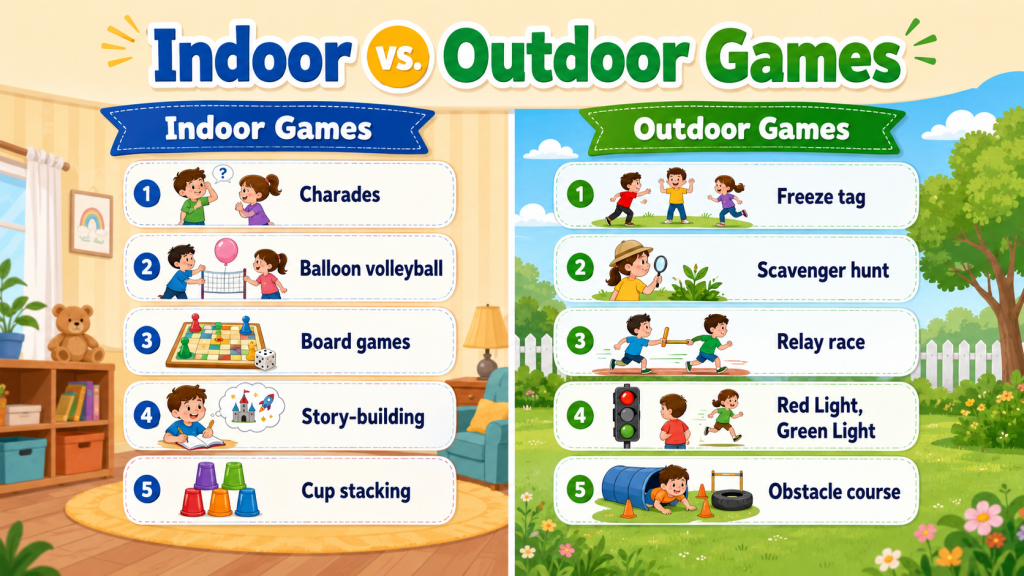
Charades
Kids act out animals, movies, chores, or emotions while others guess. It builds imagination and confidence.
Simon Says
This classic teaches listening and impulse control. Plus, “Simon says hop like popcorn” never gets old.
Hot and Cold
Hide a small object and guide the seeker with “hotter” or “colder.” It is simple, suspenseful, and oddly addictive.
These games are perfect when you are waiting at a park, hosting cousins, or trying to survive the last 20 minutes before dinner.
Outdoor Games For Kids Who Need To Move
Some kids do not have energy. They have a tiny weather system inside them. Outdoor games give that storm somewhere safe to go.
Try:
- Tag variations, like freeze tag or shadow tag
- Obstacle courses using cones, sticks, or chalk
- Relay races with silly rules
- Scavenger hunts
- Red Light, Green Light
For more seasonal inspiration, you can also explore these creative summer activities for kids to keep outdoor play fresh and easy.
Indoor Games For Friends On Rainy Days
Rainy days can either feel cozy or like the walls are slowly moving inward. Indoor games help.
Balloon Volleyball
Use a balloon and a couch, string, or tape line as the “net.” It is active but less chaotic than a real ball indoors.
Build-a-Story
A child uses just one sentence to begin a story. Each friend adds another. By the end, there may be a flying grandma, a taco spaceship, and a detective hamster. Let it happen.
Cup Stack Challenge
Kids race to stack and unstack plastic cups. It is simple, cheap, and surprisingly intense.
Team-Building Games That Build Social Skills
Friendship is not only about laughing together. It is also about figuring things out together.
Human Knot
Children form a circle, grasp the hands of two distinct individuals, and collaborate to untangle the rope without releasing it.
Blindfold Guide
One child wears a blindfold while a friend gives careful verbal directions through a safe path. This builds trust and communication.
Group Puzzle Race
Split kids into teams and give each group a small puzzle. The goal is not just finishing first. It is learning how to share roles.
These group games for children are especially useful for classrooms, youth groups, and sibling gatherings.
Quiet Games For Calm Playdates
Not every child wants loud, high-energy play. Some kids bond best through calmer activities.
Try:
- Memory card games
- Drawing prompts
- Guess the sound
- Twenty Questions
- Puzzle swaps
- Story cubes
Quiet games are also helpful for neurodivergent kids, younger children, or groups that need a reset after running around like tiny caffeinated kangaroos.
Funny Party Games For Kids
Party games should be easy to understand and fun to watch, even for kids waiting their turn.
Donut on a String
Allow children to attempt eating donuts without using their hands by hanging them from a string. Messy? Yes. Memorable? Absolutely.
Mummy Wrap
Teams wrap one player in toilet paper. The best mummy wins. Keep extra rolls handy unless you enjoy explaining the toilet paper shortage to your household.
Dance Freeze
Play music. Kids dance. Stop the music. Everyone freezes. Add themes like robot dance, animal dance, or slow-motion superhero.
Creative Games For Imaginative Kids
Some children want games with stories, characters, and big ideas.
Make a Mini Movie
Kids plan a short scene and act it out. They can create a superhero rescue, cooking show, or news report from Mars.
Restaurant Pretend Play
One child becomes the chef, another the server, another the customer. Add homemade menus for extra fun.
Invention Challenge
Give kids random safe items like paper, tape, boxes, and markers. Ask them to invent something useful, silly, or impossible.
Creative play welcomes different cultures, languages, and personalities. A child can bring in family traditions, favorite foods, or stories from home.
Games For Mixed Ages
Mixed-age groups can be tricky because older kids want challenge and younger kids want inclusion.
Choose games where everyone can participate at their level:
- Scavenger hunts with picture clues
- Partner relay races
- Drawing games
- Simple board games
- Musical statues
- Build challenges
Pair younger kids with older buddies. This helps older children practice patience and gives younger kids confidence.
How Parents Can Host Without Over-Managing
Here is the parenting tightrope: help enough, but not too much.
Set the space, explain the rules, and then step back. Kids need room to negotiate, adapt, and sometimes fail a little.
You can say:
- “How can we make this fair for everyone?”
- “What rule would help younger players?”
- “Do you want to vote on the next game?”
- “How can we solve this without quitting?”
Think of yourself as the game referee, snack supplier, and emotional air traffic controller.
Product Ideas For Fun Games To Play With Friends
Here are five game ideas that work well for playdates, family game night, parties, and screen-free afternoons.
Taco Cat Goat Cheese Pizza Wildly Entertaining Card Game
This fast-paced card game is easy to learn and designed for 2–8 players, with short 10–15 minute rounds. It works well for kids, teens, adults, and families.
Features:
- Quick rounds
- Simple rules
- Portable card format
- Great for mixed-age groups
Use cases: Best for family game night, sleepovers, travel, and kids who love silly reaction games.
Goliath The Original The Floor is Lava! Game by Endless Games
This interactive game promotes physical activity and can be played indoors or outdoors. It is a strong choice for kids who need movement instead of another sit-still activity.
Features:
- Movement-based play
- Indoor and outdoor friendly
- Great for active kids
- Easy setup
Use cases: Best for birthday parties, rainy-day energy bursts, and kids who love pretend adventure.
Spin Master Games, Hedbanz 2023 Edition
Hedbanz is a picture-guessing board game designed for two to six players who are at least six years old. Players ask questions to figure out the card on their headband.
Features:
- Question-based guessing
- Encourages communication
- Works for small groups
- New cards in the 2023 edition
Use cases: Best for shy kids, family game night, classroom fun, and conversation practice.
Hasbro Gaming Jenga Game
Jenga is a classic stacking game where players remove wooden blocks one by one without knocking the tower over. It is simple, suspenseful, and works well for kids, parents, and mixed-age groups.
Features:
- Includes 54 hardwood blocks
- Easy-to-learn rules
- Works for 1 or more players
- Great for parties, playdates, and family game night
Use cases: Best for kids ages 6+, family gatherings, classroom game time, and friends who enjoy hands-on games with a little suspense.
Kids Against Maturity: Funny Family Card Game
This family card game includes 600 question-and-answer cards in a portable box and is made for game nights, camping, sleepovers, road trips, and gatherings. It is best for families comfortable with cheeky humor.
Features:
- Large card set
- Portable storage box
- Best with groups
- Humor-based gameplay
Use cases: Best for tweens, teens, family gatherings, and older kids who enjoy silly jokes.
Research-Backed Reasons Friendship Games Matter
Fun games do more than entertain kids. They help children practice sharing, listening, problem-solving, and handling big feelings in a low-pressure way.
The American Academy of Pediatrics explains in its report on how play supports children’s social and emotional growth that play can strengthen communication, self-regulation, and healthy relationships.
Harvard’s Center on the Developing Child also shares age-friendly games that build focus, memory, and self-control, showing how simple activities can support executive function skills.
So when kids play charades, scavenger hunts, or board games with friends, they are not just having fun. They are learning how to connect, cooperate, and grow.
FAQs About Fun Games To Play With Friends
What are the best Fun Games To Play With Friends at home?
The best at-home games include charades, balloon volleyball, scavenger hunts, Hedbanz-style guessing games, cup stacking, and story-building games. Choose simple games with short rules so kids can start playing quickly.
What games help kids make friends?
Icebreakers, team challenges, cooperative puzzles, and question games help kids connect. Games like Two Truths and One Silly Fib, Human Knot, and Would You Rather make conversation feel natural instead of forced.
What are good screen-free games for playdates?
Good screen-free games include The Floor is Lava, Simon Says, freeze dance, card games, charades, obstacle courses, and drawing challenges. These games keep kids engaged without relying on tablets or TV.
How do I choose games for different ages?
Pick games with flexible rules. Pair younger kids with older helpers, use picture clues, simplify scoring, and focus on participation over winning. Movement games, scavenger hunts, and creative challenges usually work well for mixed ages.
How many games should I plan for a kids’ party?
Plan 4–6 games, but expect to use only 3–4. Kids may love one game and want to repeat it. Keep a few backup activities ready, but do not over-schedule every minute.
Conclusion
Fun Games To Play With Friends do more than fill time. They help kids laugh, move, listen, imagine, cooperate, and recover from tiny disappointments like losing a round or being tagged five seconds into freeze tag. Start simple. Choose games that match the children in front of you, not some picture-perfect version of a playdate. A deck of cards, a balloon, a backyard, or a silly question can be enough to create connection. So gather the kids, clear a little space, and let play do what it does best: bring people closer, one laugh at a time.