Spring Activities for Kids: Indoor Rainy-Day Ideas
We may earn a commission for purchases made using our links. Please see our disclosure to learn more.
Rainy spring days can feel like the universe is playing a prank on parents. The kids wake up buzzing with “spring energy,” you’re ready for fresh air… and then the sky goes gray and everyone’s suddenly bouncing off the couch like popcorn.
If you’re looking for spring activities for kids that work indoors—without needing a Pinterest-perfect setup—this is for you. You’ll get cozy, screen-light (or screen-free) ideas that actually hold attention, plus simple ways to keep mess and stress under control.
Affiliate note: This article includes a small Amazon recommendations section—at no extra cost to you, I may earn a commission if you buy through my links.
The 10-Minute Reset That Saves Rainy Days
Before you launch into “FUN MOM/DAD MODE,” try this tiny reset: name the weather, name the plan, name the win.
- “It’s rainy today.”
- “We’re doing indoor spring play.”
- “Our win is: happy kids + a calm-ish house.”
Then offer two choices (not ten). Kids do better when the day feels predictable—like you’re putting bumpers on the bowling lane. And honestly? So do we.
Make an “Indoor Spring Kit” Once, Use It All Month
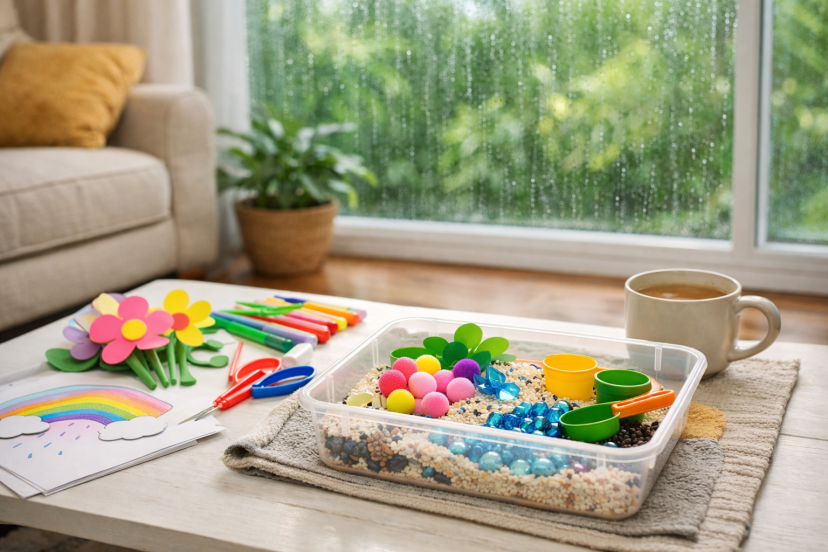
If you do one thing, do this: grab a bin or basket and make an “Indoor Spring Kit.”
Toss in:
- Paper, washable markers, tape
- Kid scissors, glue stick
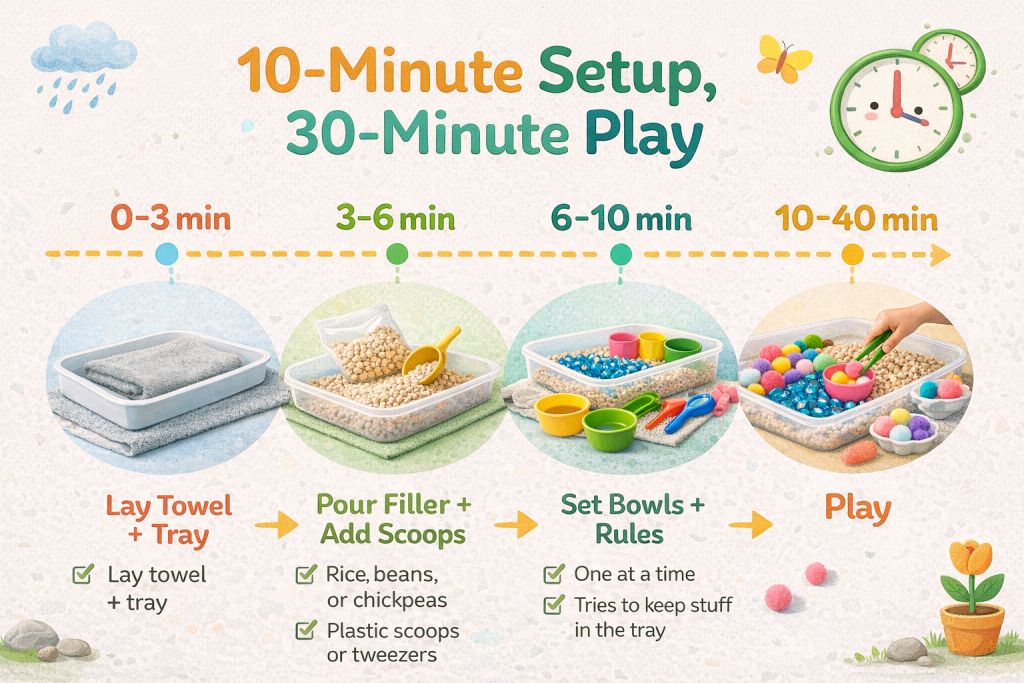
- A small tray or towel for “activity landing zone”
- A few sensory fillers (rice, dried beans, pom-poms)
- A couple of reusable containers + scoops
Now when the “I’m bored” fog rolls in, you’re not starting from zero. You’re just opening the kit like a little rainy-day treasure chest.
Sensory Spring: Bin Ideas Kids Actually Stick With
Sensory play is like coffee for a kid’s brain—calming, focusing, and somehow magical. If you want ready-to-go inspiration, borrow a few themed setups from these sensory bin ideas and adapt them with what you already have.
Three quick spring themes (no fancy supplies)
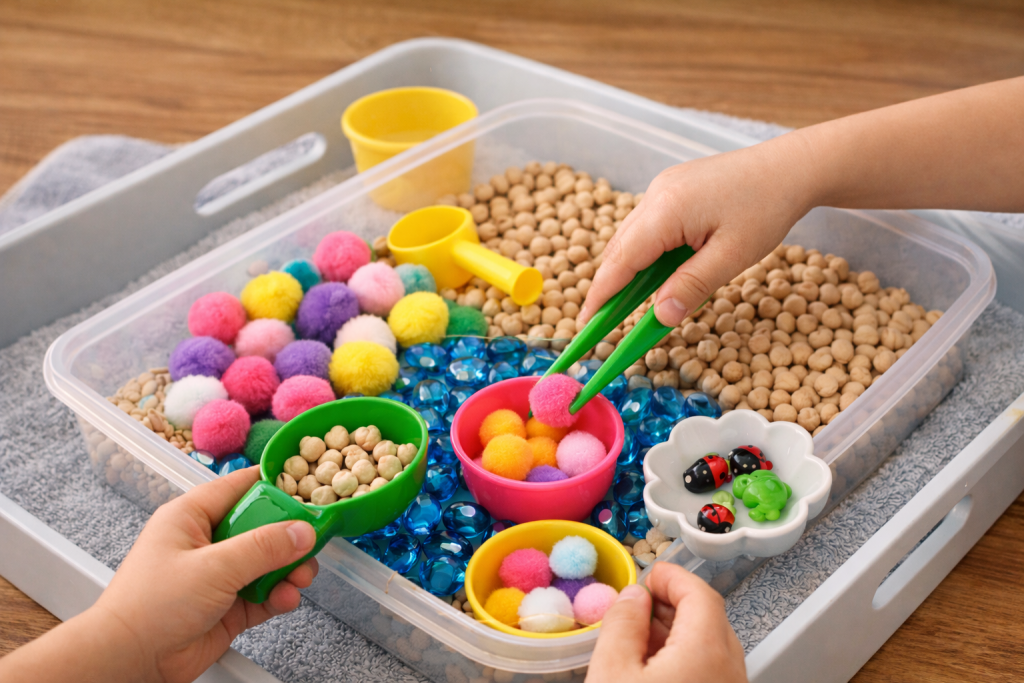
- “Rainy Garden” bin: dried beans + plastic cups + toy bugs + spoon “shovels”
- “Flower Shop” bin: pom-poms or paper petals + tongs + small bowls (sorting = secretly learning)
- “Puddle Play” bin: water + measuring cups + a towel underneath (the towel is your sanity)
Pro tip: put the bin on a baking sheet or big tray. It’s basically a spill “seatbelt.”
Rainy-Day Nature Hunt (No Backyard Required)
You can still do nature play without stepping outside.
Try a window nature hunt:
- Watch for birds, moving clouds, puddles, tree branches swaying
- Keep a “spring spotting” list: “something green,” “something flying,” “something dripping,” “a bud,” “a worm (if you’re lucky/unlucky)”
Then turn it into art: draw what you saw, make a collage, or tell a story about “the brave raindrop” who goes on an adventure.
This counts as spring learning activities and it buys you 20 minutes. Win-win.
Easy Spring Crafts With Minimal Cleanup
Crafts don’t have to mean glitter in your socks until 2040. Keep it simple and contained.
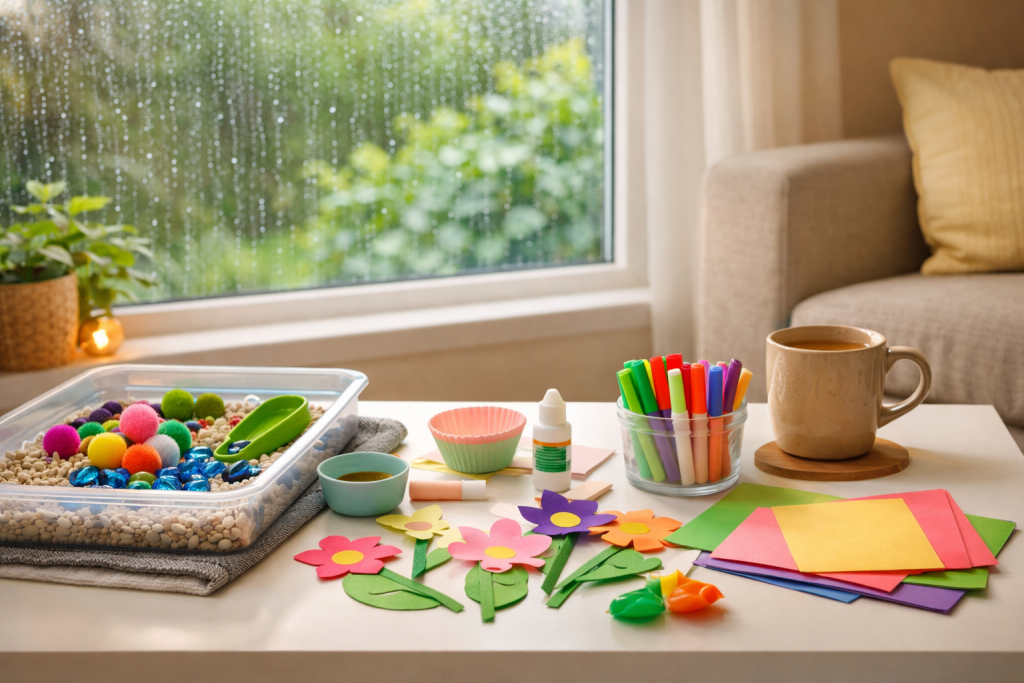
Low-mess spring crafts kids love
- Tape-resist rainbows: tape lines on paper, color over, peel tape
- Sticker scenes: “build a garden” with dot stickers + marker stems
- Coffee-filter “flowers”: color with washable markers, spritz with water, let it bloom
If you’re doing paint, use a “paint uniform” (old t-shirt) and a wipeable surface. Future-you will feel personally hugged.
Play-Dough Spring Bakery (Yes, It Counts as Learning)
Play-dough is the indoor activity equivalent of a warm blanket. Also: squeezing and rolling strengthens little hands for writing later—so it’s not “just play.”
Make it a spring bakery:
- Roll “carrot cakes,” “flower cookies,” “rain cloud buns”
- Use a fork for texture, a straw for holes, a plastic knife for “slicing”
Sneaky learning upgrades
- “Can you make 3 tiny flowers and 1 big one?”
- “Which one is taller?”
- “Let’s write a little menu together.”
That’s math, language, and fine motor skills disguised as dessert.
Indoor Obstacle Course: “Spring Animal Edition”
If the weather blocks outside play, you’ll want a quick way to burn energy indoors—because kids need movement, even on rainy days. The CDC recommends 60 minutes a day of moderate-to-vigorous activity for ages 6–17.
Set up a spring animal obstacle course:
- Hop like a bunny (pillows = lily pads)
- Waddle like a duck (masking tape line)
- Crawl like a caterpillar (under a chair tunnel)
- Flap like a butterfly (dance scarf optional)
Keep it short: 5 minutes x 3 rounds beats one long round that ends in chaos.
Kitchen Science: Simple Spring STEM Experiments
Rainy spring days are perfect for spring STEM activities—because your kitchen is basically a science lab with snacks.
Easy experiments
- Baking soda + vinegar “spring volcano” (use a tray!)
- Rainbow milk: milk + food coloring + a drop of dish soap
- Water cycle bag: draw clouds/sun on a zip bag, add water, tape to a window
Frame it like a mystery: “What do you think will happen?” Kids love being the “guessing expert.”
Storytime That Turns Into Play
Books can be a launchpad, not a sit-still test.
Try “Read 5 pages, play 5 minutes”:
- Read a spring-themed story
- Pause to act out the scene
- Let your kid be the character (you be the narrator)
Quick props from your house
- Socks = puppets
- Paper = masks
- Blanket = “rain cloud cave”
This is especially great for preschool spring activities when attention spans are… optimistic.
Music, Rhythm, and a Tiny Living-Room Parade
If your house feels cranky, music flips the mood fast.
Do a “spring parade”:
- Make instruments (rice in a container, spoon on a pot—classic hits)
- Pick a theme: “rainstorm,” “sunshine,” “garden party”
- March, freeze, march again
Add one rule: freeze like a statue when the music stops. It’s hilarious. It’s also self-control practice in disguise.
Mini Indoor Gardening for Little Hands
Indoor “gardening” can be as simple as watching something grow.
Easy options:
- Sprout beans in a jar with a damp paper towel
- Regrow green onions in water
- Plant seeds in cups and label them (“This one is mine. Do not breathe on it.”)
Kids get obsessed in the best way. And it’s a gentle lesson in patience—something we all could use.
Calm-Down Spring: Yoga, Breathing, and Mindful Art
Not every rainy day needs to be high-energy. Sometimes kids are overwhelmed and don’t know how to say it.
Try a calm combo:
- Balloon breathing: slow inhale, slow “balloon” exhale
- Animal poses: butterfly, cat, downward dog
- Mindful coloring: “color only the raindrops” or “only the flowers”
Keep your voice soft. You’re basically being the emotional thermostat.
Kindness and Community: Spring Service at Home
Spring is a great time to practice kindness—small, doable kindness.
Ideas:
- Make “thinking of you” cards for family or neighbors
- Create a “donation box” and let kids choose gently used toys
- Do a “helping hands challenge” (set the table, match socks, wipe surfaces)
Kids love feeling capable. When they feel capable, behavior improves. Not always instantly… but noticeably.
Product Picks: 5 Helpful Tools for Spring Activities
Here are five practical, low-drama helpers that fit rainy-day spring activities for kids—sensory play, crafts, and hands-on STEM.
Play-Doh Modeling Compound 24-Pack Case of Colors
Short description: A big variety pack that’s perfect for “spring bakery,” animals, flowers, and pretend play.
Features: 24 small cans, easy to share, great for color-mixing practice.
Use cases: Classrooms, siblings, playdates, toddler spring activities (with supervision).
Amazon listing shows strong review volume and high star rating.
NATIONAL GEOGRAPHIC Mega Slime Kit & Putty Lab
Short description: A science-meets-sensory kit that feels like an “event,” not just an activity.
Features: Multiple slime/putty types, experiment-style instructions, hands-on mixing.
Use cases: Rainy-day STEM, spring break activities for kids, older kids who want “real projects.”
Learning Resources Helping Hands Fine Motor Tool Set
Short description: Scoopers/tweezers/tools that turn sensory bins into fine-motor practice.
Features: Chunky grips, kid-friendly sizing, great for sorting and transferring games.
Use cases: Sensory bins, pom-pom sorting, “bug rescue” games, OT-style play.
Learning Resources Jumbo Tweezers (Set of 12)
Short description: The easiest way to upgrade any sensory bin into a focus-building activity.
Features: Big, grippy design; great for small hands learning control.
Use cases: Sorting mini “flowers,” moving “raindrops” (blue pom-poms), snack transfer games.
Crayola Washable Kids Project Paint (Neon, 10ct)
Short description: Bright spring color without the panic—washable makes it realistic to use.
Features: Washable formula, bold colors, good for big paper projects.
Use cases: Spring flowers, rainbows, handprint gardens, collaborative posters.
Research-backed: why these activities help (even when the day is messy)
Play isn’t “extra.” The American Academy of Pediatrics highlights how play supports social-emotional skills, language, self-regulation, and stress resilience—basically the stuff you really want when kids are stuck inside. See the AAP clinical report on play (2018).
Movement matters too. A systematic review/meta-analysis found that even acute bouts of physical activity can support executive function and academic-related outcomes in children—helpful fuel for focus on rainy days. Here’s the systematic review & meta-analysis on physical activity and executive function (2025).
And if you’re thinking, “My kid doesn’t move enough on rainy days”—you’re not imagining it. CDC data notes only about 24% of kids ages 6–17 get 60 minutes of activity daily.
FAQs
What are easy spring activities for kids indoors?
Think “simple and repeatable”: sensory bins, play-dough themes, tape-resist art, scavenger hunts, and short obstacle courses.
What are good rainy day spring activities for toddlers?
Try water-free sensory bins (beans/pom-poms), sticker scenes, big crayons, dance-and-freeze games, and “animal walk” races.
How do I keep indoor spring crafts from getting too messy?
Use a tray, set a “craft zone,” pick washable supplies, and keep wipes nearby. Also: one craft at a time beats a craft explosion.
What are spring STEM activities kids can do at home?
Rainbow milk, baking soda/vinegar “volcano,” a window water-cycle bag, and “sink or float” with spring-themed objects.
How long should an indoor activity last before switching?
For younger kids, 10–20 minutes is normal. Aim for a rhythm: activity → snack/water → movement → calm-down.
When spring rain traps you inside, you don’t need a perfect plan—you need a friendly one. Pick one sensory activity, one movement burst, and one calm-down option, and let the day be a little imperfect. Those “ordinary” rainy afternoons? They’re often the ones kids remember most.