5 Amazing Sensory Bins For Babies and Toddlers
We may earn a commission for purchases made using our links. Please see our disclosure to learn more.
You know that moment when your kid needs something—anything—to do with their hands… but you also don’t want to set up a whole craft explosion? Sensory Bins are for that moment.
They’re simple: a container + a safe “filler” + a few tools or toys. And somehow, it turns into 20–40 minutes of focused, happy play (the kind where you can drink your coffee while it’s still warm).
Heads up: If you buy through the Amazon picks below, I may earn a small commission at no extra cost to you.
What Are Sensory Bins (and why they feel like magic)
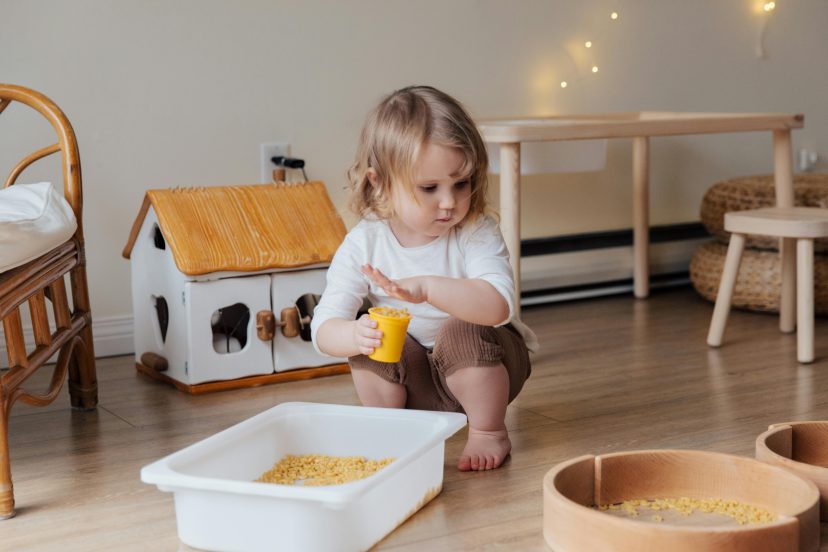
A sensory bin is a dedicated little “play zone” filled with materials kids can touch, scoop, pour, squish, hide things in, and explore. Think of it like a mini beach, a tiny construction site, or a pretend bakery—without leaving your living room.
The best part? Sensory play is open-ended. There’s no “right way” to do it. Your toddler might spend 10 minutes just pouring rice from cup to cup like they’re running a tiny café. That still counts.
What makes a bin “work”
- One main texture (rice, oats, water, sand, dough)
- 2–4 simple tools (scoop, cup, tongs, funnel)
- A theme (optional, but fun)
Why Sensory Bins Work (Calm hands, busy brains)
Sensory bins look like “just play,” but you’re quietly building real skills:
- Fine motor skills: pinching, grabbing, squeezing, tong work
- Hand-eye coordination: pouring, transferring, sorting
- Language growth: “full/empty,” “sticky/dry,” “more/again”
- Self-regulation: repetitive play can feel calming (like a fidget toy… but bigger)
And honestly? They’re a lifesaver when your kid has that wiggly, restless energy and you need a gentle reset.
A quick real-life example
One parent I know called it “the bin tax.” Whenever their toddler got clingy while they cooked dinner, they’d pull out a simple scoop-and-pour bin. No screens, no meltdown—just busy hands and a calmer kitchen.
Sensory Bin Safety Rules (Non-negotiables)
I’m going to be the slightly-annoying friend for a second: safety matters a lot here, especially for babies and young toddlers.
The big rules
- Always supervise (especially under age 3).
- Avoid choking hazards (anything smaller than a cheerio is risky for babies; even for toddlers, be cautious).
- Skip sharp/pointy items (even dried pasta can be surprisingly pokey).
- Watch allergies (flour, gluten, scents, food dyes).
- Keep it clean (washable tools, dry fillers stored sealed).
Taste-safe vs. not taste-safe
If your child still mouths everything, stick with taste-safe sensory bins (oats, yogurt, cooked pasta, chia “slime,” etc.). You’ll relax more—and your kid will play better when you aren’t saying “noooo don’t eat that” every 12 seconds.
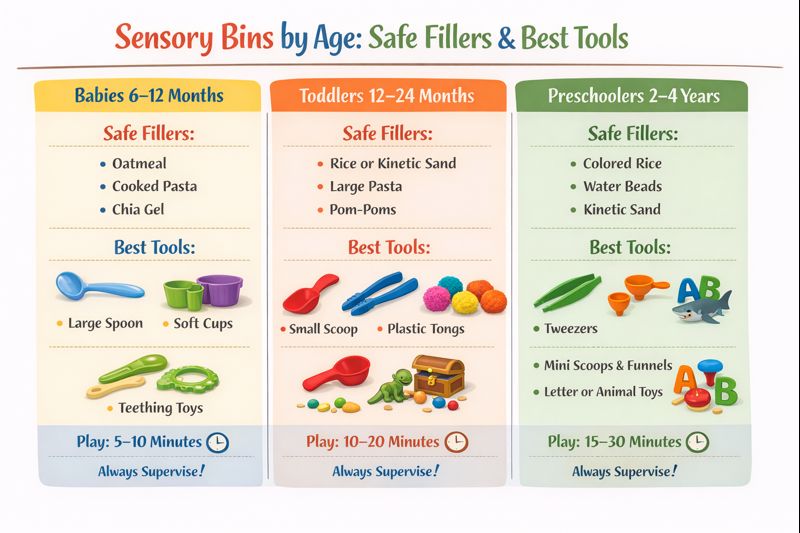
Pick the Right Bin by Age (So it’s fun, not stressful)
Not every sensory bin fits every stage. Match it to what your child can handle right now.
Babies (6–12 months)
- Taste-safe fillers only
- Big items they can’t swallow
- Short play sessions (5–10 minutes is plenty)
Toddlers (12–24 months)
- Larger scoops, cups, chunky objects
- Simple “find and grab” games
- Clear boundaries (“hands stay in the bin”)
Toddlers + Preschool (2–4 years)
- Tongs, tweezers, sorting games
- Themed bins (animals, vehicles, colors, letters)
- Pretend play (bakery, car wash, garden)
Set Up in 5 Minutes (My “real-life parent” method)
If you’ve ever abandoned a Pinterest activity halfway through setup… same. Here’s the low-effort way.
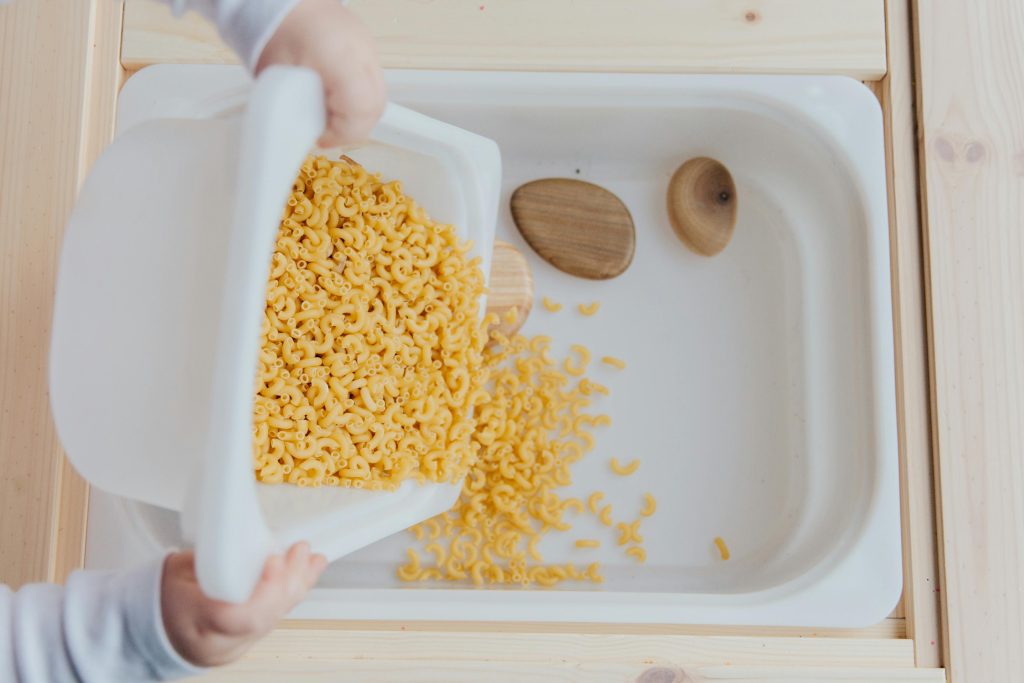
The 5-minute setup checklist
- Bin: any shallow tub, storage container, or dish pan
- Base filler: pick one texture
- Tools: 2 cups + 1 scoop (start here)
- Extras: 5–10 objects to hide or sort
Pro tip: put an old towel or a sheet under the bin. Not because you’re messy—because kids are committed to chaos.
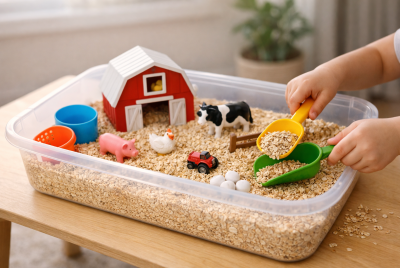
Sensory Bin #1: Taste-Safe Oatmeal “Breakfast” Bin (Baby-friendly)
This one is gold for babies and young toddlers because it’s soft, safe, and easy.
What you need
- Dry oats (or cooked/cooled oats for extra safety)
- A couple of silicone spoons
- Large measuring cups or chunky bowls
How to play
Let your baby:
- pat it
- scoop it
- sprinkle it
- “feed” a teddy (with you supervising)
What they’re learning
They’re practicing early sensory exploration and cause-and-effect (“When I dump, it falls!”). It’s basically baby science… with oats.
Sensory Bin #2: Rainbow Rice Treasure Hunt (Toddler classic)
This is the sensory bin that makes kids look like they’re “studying” because they get so focused.
What you need
- Colored rice (or plain rice)
- Small cups + a scoop
- A few large items to hide (big beads, chunky shapes, toy bugs)
How to play
Hide items under the rice and ask:
- “Can you find the blue star?”
- “How many bugs can you rescue?”
- “Let’s sort by color!”
Make it less messy
Keep the rice level low at first—just a thin layer. You can always add more once your toddler learns the “bin stays in the bin” rule (a rule they will test like it’s their job).
Sensory Bin #3: Water + Sponge “Car Wash” Bin (Low prep, big payoff)
If your kid loves water but you hate the cleanup… this one meets you in the middle.
What you need
- A shallow bin with warm water
- Sponges + a small cup
- A few toy cars (or animals, or plastic kitchen tools)
How to play
- “Wash” the cars with sponge suds (optional: a drop of baby soap)
- Pour water into cups
- Squeeze sponges into a “bucket”
Why kids love it
Squeezing sponges is weirdly satisfying. It’s hand strength + sensory input + pretend play all in one.
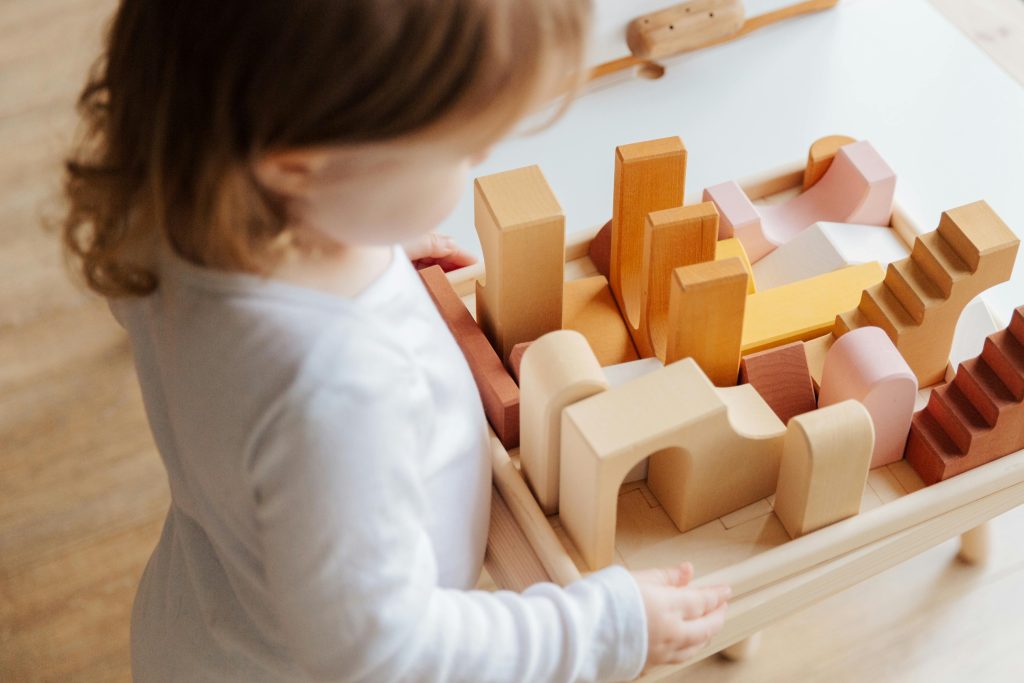
Sensory Bin #4: Nature Sort & Match Bin (A calm, earthy favorite)
This one feels like a mini outdoor adventure—great for families who live in apartments and don’t always get outside as much as they want.
What you need
- Leaves, pinecones, smooth stones (big enough not to swallow)
- A muffin tin or divided tray
- Optional: toy insects or animals
How to play
- Sort by size (“big/small”)
- Sort by type (“leaf/pinecone/rock”)
- Build “habitats” for toy animals
Make it culturally fun
If your family has roots in a place where markets are full of spices, seeds, or textured goods, you can recreate that vibe with safe, large natural objects and talk about what you remember: “This leaf reminds me of…” Kids love personal stories.
Sensory Bin #5: Cloud Dough Bakery Bin (Soft, cozy, and pretend-play friendly)
This one feels like the sensory version of a warm blanket.
What you need
- Cloud dough (mix flour + oil) or use taste-safe alternatives for younger kids
- Cookie cutters or safe kitchen tools
- A couple of cupcake liners
How to play
Open a pretend bakery:
- “Can I order a cookie?”
- “Let’s make 3 muffins.”
- “Can you roll a ball and flatten it?”
Why this is great for self-regulation
Soft textures + repetitive shaping often helps kids settle, especially after daycare or a busy outing.
Rotate + Store Sensory Bins (So they don’t become “the mystery box”)
Sensory bins work best when they feel “new,” even if you’re reusing the same stuff.
Easy rotation ideas
- Keep 2–3 bins in a closet
- Swap them every few days
- Change one thing (new scoop, new theme objects)
Storage tips
- Dry fillers (rice, oats) → airtight container
- Tools → zip bag inside the bin
- Label the lid (“Rice Bin,” “Car Wash Bin”) so you aren’t guessing later
When Your Kid Hates Mess (Yes, that’s normal)
Some kids love messy play. Others act like a single grain of rice is a personal insult.
Try this gentle ramp-up
- Start with tools first (scoop/tongs) so they don’t touch the filler directly
- Offer a “wipe station” (wet cloth nearby)
- Do short sessions (2–5 minutes)
- Let them watch you play first
And remember: refusal doesn’t mean failure. It just means your child is learning their own comfort level.
Sensory Bins for Sensory Sensitivities (Support without pressure)
If your child seeks sensory input (always jumping, crashing, chewing) or avoids it (hates sticky textures, covers ears), sensory bins can help—but keep it light.
A helpful mindset
Think “invitation,” not “assignment.”
- Sensory seekers often enjoy heavier input: kinetic sand, water play, scooping
- Sensory avoiders may prefer dry, predictable textures: large pom-poms, big pasta (3+), fabric scraps
If you suspect bigger sensory challenges, you can also ask your pediatrician about an occupational therapy evaluation. You don’t need to DIY everything alone.
Amazon Favorites to Build a Sensory Bin Kit
These are solid, low-regret basics that help you build Sensory Bins without overthinking it. All meet the criteria (4.2★+ and 300+ reviews) based on the listings below.
1) Sterilite 16 Quart Basic Clear Storage Box with White Lid
Short description: A simple, clear bin that’s easy to store and easy to wipe down.
Features: Lidded storage, see-through sides, stackable.
Best for: Your “main bin” for rice, oats, water play (dry it after), or themed setups.
2) Kinetic Sand 2lb Resealable Bag
Short description: Moldable sand that sticks to itself more than your floor (bless).
Features: Soft texture, easy shaping, resealable storage.
Best for: Calming play, building, squeezing, and “I need a quiet moment” afternoons.
3) Learning Resources 3 Prong Tong (Set of 6)
Short description: Beginner-friendly tongs for transferring games.
Features: Great for hand strength, easier grip than skinny tweezers.
Best for: Toddlers who love moving tiny things from cup to cup (and feeling very important).
4) Learning Resources Gator Grabber Tweezers (12 Pieces)
Short description: Chunky tweezers that “bite” objects like little alligators.
Features: Encourages pincer grasp, fun character design.
Best for: Pom-pom rescue, bead transfers (3+), “feed the gator” games.
5) Safari Ltd. Ocean TOOB (mini ocean animals)
Short description: A themed set that instantly makes a bin feel like a world.
Features: Variety pack, great for pretend play and sorting.
Best for: Ocean bins with kinetic sand, water “tide pools,” or nature sorting.
Quick cleanup note: If sensory play ends up in your baby’s hair (it happens), you might like this guide on gentle options: baby hair products for sensitive little scalps.
What Research Says About Sensory Play (and why it matters)
You don’t need a textbook to justify Sensory Bins—your kid’s focus and joy already tell you a lot. Still, it’s nice to know experts back you up.
Play supports development in real, practical ways
The American Academy of Pediatrics highlights play as a key driver for healthy development—supporting things like stress regulation, social-emotional growth, and parent-child connection. That’s a big reason sensory play works so well: it’s hands-on, responsive, and naturally engaging. (AAP clinical report, 2018)
Sensory exploration can be a strong alternative to passive time
A 2024 study on toddlers’ tactile exploration found links between higher screen exposure and weaker tactile exploration skills, and it emphasizes the value of giving children real-world, hands-on ways to explore objects. Sensory bins fit that need nicely because they invite touch, movement, and curiosity in a low-pressure way. (Gillioz et al., 2024)
Sensory Bins FAQs
Are Sensory Bins safe for babies?
Yes—if you keep them taste-safe, use large objects only, and supervise the entire time. For babies, think oats, yogurt “paint,” or cooked pasta (cooled), not rice or beans.
How often should I use Sensory Bins?
2–4 times a week works great for many families. Even once a week helps. The goal is consistency, not perfection.
What’s the best filler for beginners?
Dry oats or kinetic sand are beginner-friendly. They’re easy to scoop, easy to store, and not instantly chaotic like glitter-level fillers.
What can I do to keep my child from throwing everything out?
Start with a thin layer of filler, use a “bin stays on the mat” rule, and give them a dumping option (like a cup-to-cup station). Toddlers dump because dumping is science.
Can Sensory Bins help with tantrums?
They can help with the before—that restless, dysregulated buildup. Many kids calm down with repetitive scooping and pouring because it gives their body steady sensory input.
Conclusion
Sensory Bins don’t need to be fancy to be powerful. Start small: one bin, one texture, two tools. Let your child explore in their own way, at their own pace. Over time, you’ll build a little library of calming, skill-building activities you can pull out anytime—especially on the days that feel a bit too loud. If you try one this week, make it the easiest one… and call that a win.