Baby Hair Products Guide: What to Use (and Avoid)
We may earn a commission for purchases made using our links. Please see our disclosure to learn more.
The first time you try to “do” your baby’s hair, it can feel weirdly high-stakes. Like… why is something so tiny getting so tangled? Why does the scalp smell like milk and sunshine? And why does every bottle of baby hair products claim it’s “gentle,” “natural,” and “tear-free,” like that’s supposed to settle your nerves?
This guide is your calm, practical “friend on the bathroom floor” walkthrough. We’ll cover what baby hair products actually help, what to skip, how to read labels without a chemistry degree, and how to build a simple routine that works—whether your baby has wispy newborn hair, thick curls, or a scalp that’s prone to dryness and cradle cap.
Affiliate note: The Amazon picks below are affiliate-style recommendations (I may earn a commission if you purchase).
Baby hair is different (and it’s not just “mini adult hair”)
Baby hair and scalp are still developing. The scalp barrier can be more sensitive, and baby hair is often finer and easier to knot—especially around the nape of the neck where milk dribbles and collars rub.
That’s why the “strong clean” products adults tolerate can feel harsh on babies. With baby hair products, the goal isn’t squeaky—it’s comfortable: clean enough to prevent buildup, gentle enough to avoid dryness, and simple enough that you’re not doing a 12-step routine before bedtime.
Helpful mindset: Think “cashmere sweater,” not “dirty sneakers.”
When you actually need baby hair products (and when water is enough)
If your baby has very little hair, no odor, and no scalp issues, you can keep things super minimal. Many parents do fine with warm water and a soft washcloth most days, then use a mild cleanser occasionally.
Once you notice any of these, baby hair products start earning their place:
- Milk/food residue (hello, sticky neck rolls)
- Sweat (especially in warm climates)
- Cradle cap flakes
- Tangles, especially with longer baby hair or curls
- Dry patches on the scalp
And if your baby hates bath time? Fewer products can actually make things easier—less rinsing, less fuss.
The label-reading cheat sheet for baby hair products
This is the part nobody teaches you, so here’s the shortcut.
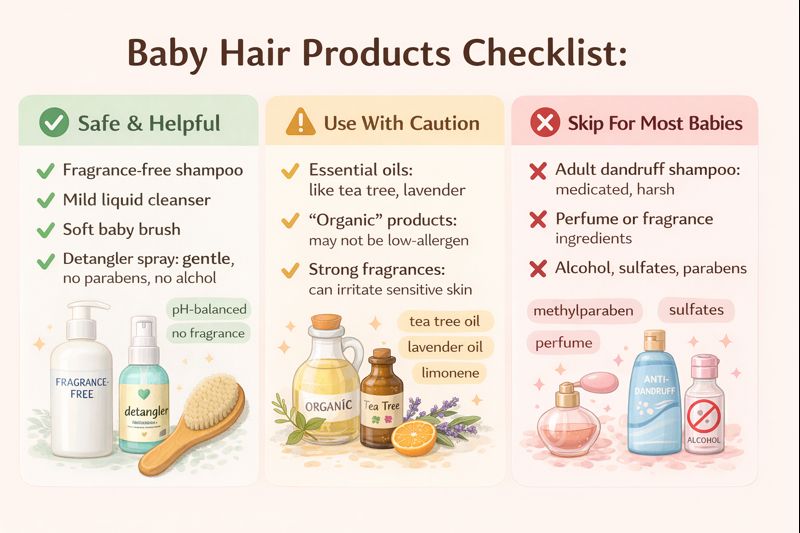
Look for “yes” ingredients
- Mild surfactants (gentle cleansers) that won’t strip the scalp
- Humectants like glycerin (helps hold moisture)
- Skin-supporting ingredients like ceramides (help with dryness-prone skin)
Be cautious with “maybe” ingredients
- Fragrance (even “natural fragrance”) if your baby has sensitive skin
- Essential oils on very young babies or allergy-prone skin (they’re natural, yes—also sometimes irritating)
A quick note on marketing claims
A peer-reviewed study assessing best-selling baby cleansers found that “hypoallergenic” or “allergy-tested” marketing didn’t necessarily match lower allergen content. In other words: the label can be reassuring, but ingredients matter more.
Baby shampoo: how to pick the right one
A good baby shampoo does three things:
- Cleans without stripping
- Rinses easily
- Doesn’t leave the scalp tight or itchy
If you’re choosing baby hair products for everyday use, aim for:
- Fragrance-free or lightly fragranced (especially for sensitive skin)
- Simple formulas
- Clear “hair + body wash” use if you want one bottle to rule them all
Real-life tip: If your baby’s scalp looks dry after washing, it’s not “just winter.” Try washing less often or switching to a milder cleanser.
Claims decoded: tear-free, hypoallergenic, “natural”
“Tear-free”
Usually means the formula is designed to reduce stinging, but it doesn’t guarantee zero eye irritation. Still: it’s a helpful feature if your baby turns head-washing into a full-body sport.
“Hypoallergenic”
There isn’t one universal standard across brands. Use it as a starting point, then check ingredients—especially if your baby has eczema or rashes.
“Natural”
Natural isn’t automatically gentler. Poison ivy is natural too. (Not a vibe for bath time.)
Conditioner & leave-ins: when they actually help
A lot of babies don’t need conditioner. But leave-in baby hair products can be a lifesaver if your baby has:
- curls/coils
- longer hair that mats at the back
- dryness from frequent bathing (or frequent wiping… because life)
What to use instead of heavy conditioner
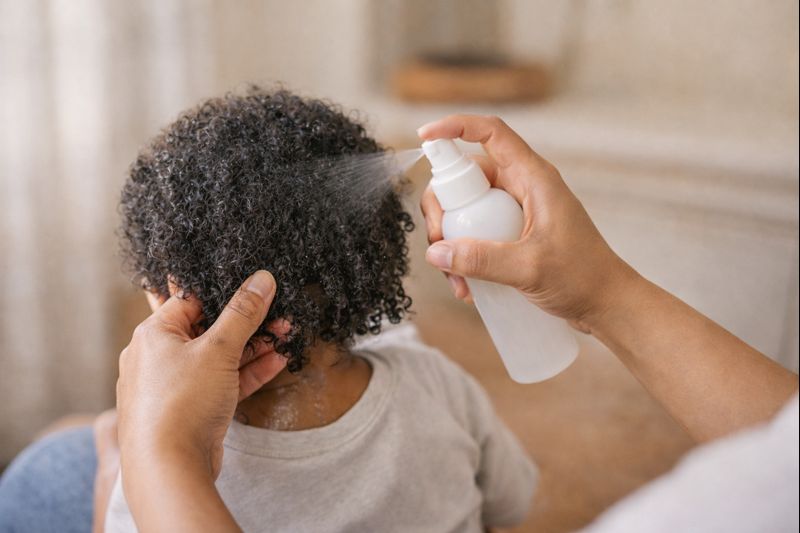
- A light leave-in spray
- A tiny amount of baby-safe conditioner on the ends only
- A detangler for quick comb-outs
Analogy that fits: Conditioner for babies is like lip balm. You don’t need it all the time—but when you need it, you really need it.
Detangling and brushing: the no-tears routine
Tangles don’t mean you’re doing something wrong. Baby hair tangles because it’s fine and rubs against everything.
The simplest detangling routine
- Mist a detangler or leave-in on damp hair
- Finger-detangle first (gentle, slow, patient)
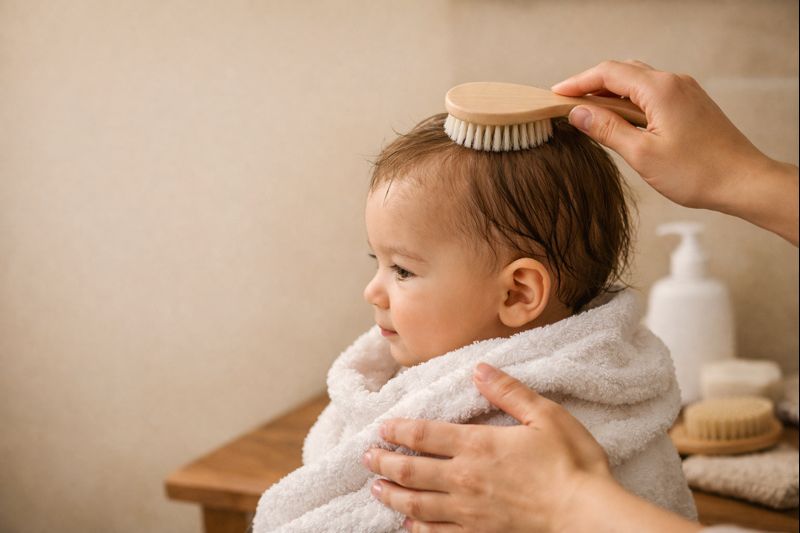
- Use a wide-tooth comb or soft brush
- Start at the ends, then move up
If your baby has textured hair, detangling on damp hair with product is usually kinder than dry brushing.
Baby hair oil: soothing or slippery?
Hair oil can be great… or totally unnecessary. It’s most helpful for:
- dry scalp
- cradle cap softening
- very textured hair that needs extra moisture
Less is more. With baby hair products like oils, too much can turn into buildup (and make cradle cap worse).
Safe approach: Use a few drops on fingertips, warm it up, then gently pat—not drench.
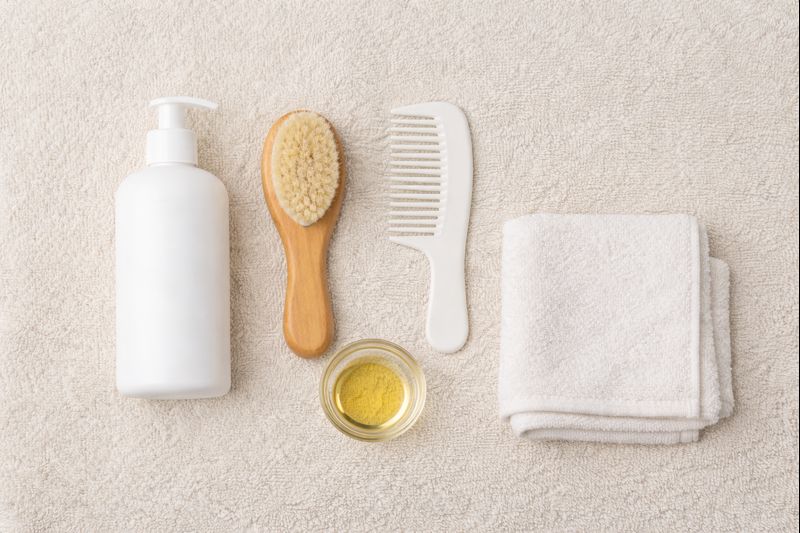
Cradle cap: gentle treatment steps that actually work
Cradle cap is common and usually harmless, but it can look dramatic (like your baby is auditioning for a snow globe).
A review on infantile seborrheic dermatitis notes it’s very common, with high point prevalence reported in the first months of life.
A gentle cradle cap routine
- Before bath: soften flakes with a small amount of oil for 10–15 minutes
- During bath: wash with a mild cleanser
- After bath: use a soft brush/comb to lift loosened flakes (no scraping)
Call your pediatrician if you see redness that spreads, weeping/oozing, a strong odor, or if your baby seems uncomfortable.
Sensitive scalp, eczema, and allergy-prone babies
If your baby has eczema, allergy history, or unexplained rashes, keep baby hair products extra simple:
- fragrance-free
- minimal ingredients
- no essential oils (at least until you know how skin reacts)
Also: don’t introduce three new products at once. If something irritates your baby, you’ll want to know which one did it.
Baby hair products for different hair textures
Straight or fine hair
- Mild shampoo 1–2x/week
- Light detangler only if needed
- Skip heavy oils most of the time
Wavy or curly hair
- Gentle cleanser less often
- Leave-in conditioner or detangler for comb-outs
- A little oil can help with dryness (light touch!)
Coily or very textured hair
- Focus on moisture and gentle detangling
- Leave-in + careful combing on damp hair
- Consider protective styles that reduce tangling (soft, not tight)
Cultural note (because this matters): Many families have beautiful traditions around oiling hair, protective styling, and hair care rituals. Keep the heart of those traditions—just go gentle, avoid tight pulling, and watch for scalp irritation.
How often to wash baby hair (simple schedules)
More washing isn’t always better. Dermatologists note newborns typically don’t need frequent baths; 2–3 times a week is often enough, as long as diaper areas are cleaned regularly.
Mayo Clinic similarly notes there’s usually no need for daily bathing, and too much bathing can dry skin.
A practical rhythm:
- Newborns / minimal hair: 1–2x/week hair wash
- More hair / sweaty baby: 2–3x/week
- Cradle cap: short, gentle routine during baths, not aggressive scrubbing
Bath-time technique: applying products without drama
If bath time is already chaotic, baby hair products should reduce chaos, not add it.
Quick technique that helps
- Use less product than you think
- Lather in your hands first (not directly on scalp)
- Rinse with a cup while shielding the forehead with your hand
- Towel blot—don’t rub
And if your baby screams during hair rinses? You’re not failing. You’re just parenting a tiny, slippery opinionated person.
Product Picks: 5 Baby hair products worth considering
Below are five commonly well-reviewed, widely used baby hair products and tools that fit real parent needs (gentle cleansing, tangles, curls, cradle cap, sensitive scalps). Note: Some Amazon pages don’t reliably display star/review counts in plain-text previews, so I’m focusing on established, high-demand items and clear use-cases (and you can quickly confirm rating/review totals directly on Amazon).
1) CeraVe Baby Wash & Shampoo (Tear-Free)
Why it’s popular: Simple, gentle cleansing that’s often chosen for sensitive, dryness-prone skin.
Features: Tear-free cleanser, moisturizing support, easy rinse.
Best for: Babies with dry skin, parents who want one bottle for hair + body.
2) Mustela Cradle Cap Foam Shampoo for Newborns
Why it’s popular: Designed specifically for cradle cap routines.
Features: Foam format for quick application, targeted for flaky scalp.
Best for: Babies with cradle cap and parents who want a purpose-built option.
3) Johnson’s No More Tangles Detangling Spray
Why it’s popular: A classic detangler option for knots and morning hair chaos.
Features: Lightweight spray, helps reduce tugging during comb-outs.
Best for: Longer baby hair, toddler transitions, quick detangling days.
4) SoCozy Kids Leave-In Conditioner Spray
Why it’s popular: Lightweight moisture for tangles and textured hair days.
Features: Leave-in softness, helps with combing and frizz control.
Best for: Curls/waves/coils, dry ends, “we need this done in 60 seconds” mornings.
5) FridaBaby DermaFrida The FlakeFixer (Cradle Cap Brush Kit)
Why it’s popular: A tool-based approach for gentle scale loosening.
Features: Multi-step brushing/comb tool set for cradle cap care.
Best for: Parents who prefer mechanical removal after softening with oil and washing.
Tiny parent-life bonus: If you’re trying to build smoother routines overall (bath nights, getting dressed, morning flow), you might also like these kids chore chart ideas that make routines feel less chaotic—especially once your baby becomes a toddler tornado.
Research-Backed Credibility: What Studies and Experts Say
If you’ve ever wondered whether your baby really needs a full lineup of baby hair products, research suggests you can keep things simple—especially early on.
1) Water alone (or a mild cleanser) is often enough for newborns.
An evidence-based neonatal skin care consensus published in 2023 explains that bathing with water alone—or using a gentle liquid cleanser—can be appropriate and may not disrupt a newborn’s developing skin barrier. In other words, you don’t have to overdo it to do it right. Here’s the source: evidence-based newborn skin care recommendations (2023).
2) “Hypoallergenic” labels don’t always mean fewer irritants.
A 2024 study analyzing best-selling baby cleansers (including products from Amazon listings) found that marketing claims like “hypoallergenic” didn’t consistently match lower levels of potential allergens. Translation: when choosing baby hair products, it’s smart to look past the front label and pay attention to ingredients—especially if your baby has sensitive skin. You can read it here: study on potential allergens in best-selling baby cleansers (2024).
FAQs
How do I choose baby hair products for sensitive skin?
Go fragrance-free, keep ingredients minimal, and introduce one product at a time. If irritation shows up, stop and check with your pediatrician—especially if there’s redness, oozing, or swelling.
Which baby hair products are beneficial for cradle cap?
The gentlest combo is: soften flakes (tiny bit of oil), wash with a mild cleanser, then use a soft brush/comb to lift what loosens. Avoid scraping or picking.
Can I use baby hair products on a newborn?
Usually yes—but you often don’t need much. Many experts suggest mild cleansing routines and not over-washing. If you use shampoo, use a tiny amount and rinse well.
How frequently should I wash my baby’s hair?
A common rhythm is 1–2 times per week for newborns and 2–3 times per week for older or sweatier babies. More washing can dry skin.
Are “natural” baby hair products always safer?
Not always. “Natural” can still include irritants (especially essential oils). For reactive skin, prioritize gentle, fragrance-free formulas over trendy labels.
Final thoughts
If you take one thing from this: baby hair products should make your life easier, not more complicated. Start simple. Watch your baby’s scalp. Adjust slowly. And remember—there’s no prize for the fanciest routine. The win is a comfy baby, fewer tangles, and a bath-time vibe that feels a little more peaceful than yesterday.