Best Art Supplies for Kids: A Practical Buying Guide
We may earn a commission for purchases made using our links. Please see our disclosure to learn more.
A box of crayons can become a rocket blueprint, a family portrait, or a page of joyful scribbles. Still, buying art supplies for kids is not as simple as choosing the biggest set. Parents also need to consider age, cleanup, storage, durability, and how a child actually likes to create.
This guide compares useful starter supplies, complete kits, paints, drawing tools, and mixed-media materials. You will find six carefully selected products, practical safety guidance, and advice for different budgets and living spaces. The aim is to choose a manageable collection that invites regular creativity without making cleanup overwhelming.
Affiliate disclosure: We may earn a commission from qualifying purchases made through links associated with this article, at no extra cost to you.
What to Look for in Art Supplies for Kids
Start with how your child creates. A frequent doodler may value dependable pencils and markers more than hundreds of craft pieces, while a preschooler who enjoys sensory play may prefer chunky crayons and washable paint. Good art supplies for kids should be easy to hold, simple to open, age-appropriate, and realistic for your cleanup routine. Also check whether favorite consumables can be replaced separately.
Start With Your Child’s Age and Development
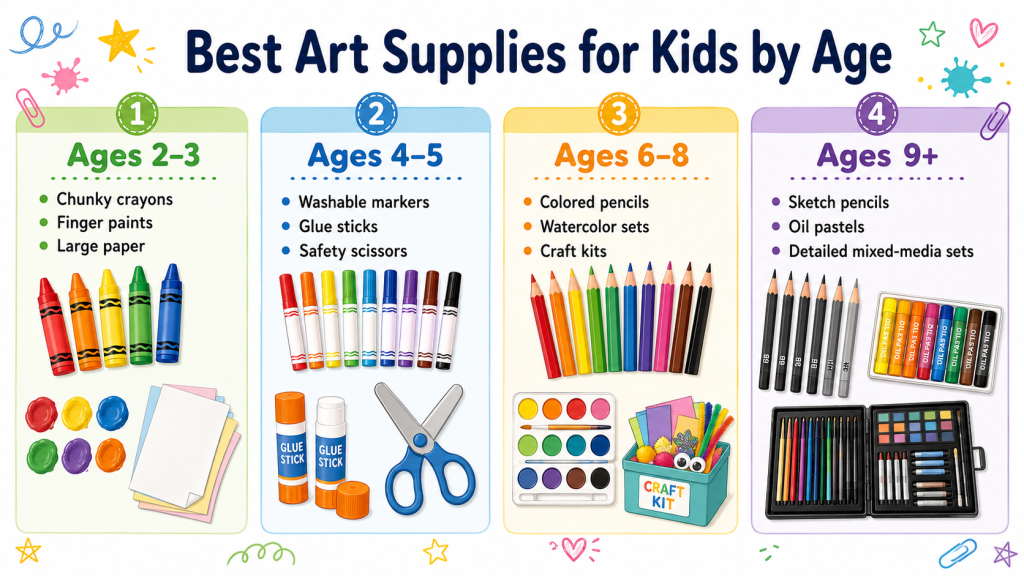
Age labels on art supplies for kids matter because grip, coordination, attention, and mouthing habits change quickly. Toddlers generally need broad tools, large surfaces, and close supervision. Preschoolers can explore suitable scissors, glue, paint, and collage materials, while older children may enjoy finer pencils or watercolor techniques.
For younger preschoolers, Parentloom’s guide to simple, safe nursery art activities offers age-aware ideas before you expand the supply shelf.
How to Check Labels on Art Supplies for Kids
Read the package before focusing on colors. In the United States, “Conforms to ASTM D-4236” indicates that an art material has undergone review for potential chronic health hazards and carries relevant precautions. It does not mean the product suits every age or use.
Choose clearly labeled, age-appropriate products and retain the packaging. The American Academy of Pediatrics also advises favoring water-based, unscented options for routine children’s art. Supervision, handwashing, ventilation when directed, and preventing ingestion still matter.
Build a Useful Starter Kit Without Overspending
A starter set of art supplies for kids can begin with crayons or colored pencils, washable markers, paper, suitable scissors, glue, paint, and a few brushes. Add modeling or collage materials after your child shows interest. Spend more on repeatedly used tools, then save on paper by mixing drawing sheets, recycled cardboard, and heavier paper for wet media. This lets the collection grow around real habits instead of hopeful purchases.
Best Art Supplies for Kids: Six Recommended Products
These art supplies for kids serve different ages, creative styles, budgets, and homes. Choose the strongest match rather than several overlapping kits.
| Product | Best fit | Format | Consideration |
| Crayola Inspiration Art Case | Portable drawing | Mixed dry media | Ages 5+ |
| Kid Made Modern Library | Open-ended crafting | Loose components | Small parts |
| Faber-Castell Essentials | Developing skills | Multiple media | Less portable |
| Ooly Chunkies | Low-prep painting | Paint sticks | No brush practice |
| Crayola Washable Paint | Basic painting | Liquid paint | Needs drying space |
| Arteza Watercolor Set | Watercolor practice | Paint and paper | Small sheets |
Crayola Inspiration Art Case, Tie-Dye, 140 Count
Best for: A portable all-in-one drawing kit
The organized case contains crayons, washable markers, short colored pencils, and large paper sheets. It gives children several familiar drawing options without requiring separate boxes, making it practical at home or on trips. The variety is useful, although the manufacturer positions the set for children age five and older.
Kid Made Modern Arts and Crafts Library
Best for: Older children who enjoy open-ended mixed-media projects
This collection includes pipe cleaners, pom-poms, craft sticks, beads, sequins, googly eyes, glue, scissors, and other components for building imaginative projects. It suits children who prefer making objects to filling coloring pages. Because the box contains small loose pieces and tools such as needles, follow the listed age guidance and supervise appropriately.
Faber-Castell Young Artist Essentials Gift Set, 64 Pieces
Best for: A child ready for a more focused art set
This wooden-box set includes colored and watercolor pencils, graphite pencils, oil pastels, washable dual-tip markers, paper, a sharpener, and a brush. It helps a developing artist compare several drawing media while fitted trays keep tools orderly. The substantial presentation box, however, is less convenient for everyday travel.
Ooly Chunkies Tempera Paint Sticks, Set of 24
Best for: Low-prep painting in small or shared spaces
These twist-up tempera sticks provide classic, pastel, and metallic colors without cups of water or wet brushes. They dry quickly and are listed for ages three and older, which helps when table space or cleanup time is limited. Their solid texture differs from liquid paint, so they do not teach brush loading or dilution.
Crayola Washable Kids Paint, 6 Count
Best for: A simple, affordable liquid-paint set
This six-color set introduces brush painting, mixing, handprints, and broad paper projects. Its creamy paint is designed to wash from skin and most washable clothing, a practical feature for routine family use. Six shades may feel limited for a frequent painter, but they provide a sensible starting palette.
Arteza Kids Watercolor Painting Art Set
Best for: Children curious about watercolor techniques
The kit pairs 36 watercolor colors with a water-brush pen and 30 foldable sheets of thick watercolor paper. Its included surfaces make starting easy. The compact sheets help contain projects, although children who enjoy broad, sweeping paintings may need larger watercolor paper separately.
Match the Medium to How Your Child Creates
Watch what happens with blank paper. Some children outline stories with markers; others cut, tape, build, and attach. Dry media supports frequent independent use. Paint encourages broader movement and mixing but needs preparation. Collage materials invite construction, while watercolor rewards patience and lighter control. The right medium can make a modest set more appealing than a large collection.
Decide Between Complete Kits and Individual Supplies
When comparing art supplies for kids, complete kits simplify gifts, travel, and first-time setup, yet some contain duplicate colors or filler pieces. Individual supplies offer more control over quality, quantity, and replacement. For many families, a compact core kit plus a few high-use refills creates the best balance: enough variety to explore without paying repeatedly for tools a child rarely chooses.
Plan for Mess, Cleanup, and Storage
Decide where wet work will dry before buying paint. “Washable” does not guarantee removal from every porous surface, so protect tables and clothing. Store everyday art supplies for kids in shallow bins, divided trays, or pencil cups. Keep adult-supervised tools separate, close glue promptly, cap markers, and allow brushes to dry before storage.
Research-Backed Guidance on Creative Play and Safety
Research supports creative activity broadly, but it does not show that one brand or an oversized kit improves development. The American Academy of Pediatrics explains that play can support cognitive, language, social-emotional, and self-regulation skills. Art can be one form of that play alongside other activities. See the AAP clinical report, The Power of Play.
A 2023 randomized study of 60 boys ages seven to nine found that a program combining visual-art activities with motor-accuracy exercises improved manual dexterity, motor accuracy, and reaction time. However, the short study included only boys and tested a combined program; it cannot show that buying more supplies creates the same effect. Read Optimizing Fine Motor Coordination, Selective Attention and Reaction Time in Children.
The practical buying lesson is clearer: choose developmentally appropriate materials, read warnings, avoid small parts for children under three, and value supervision over broad marketing terms. The U.S. Consumer Product Safety Commission’s art-material guidance explains labeling requirements, while the AAP’s safe art-and-craft supply guidance offers household precautions.
Art Supplies for Kids in Small Spaces and Shared Homes
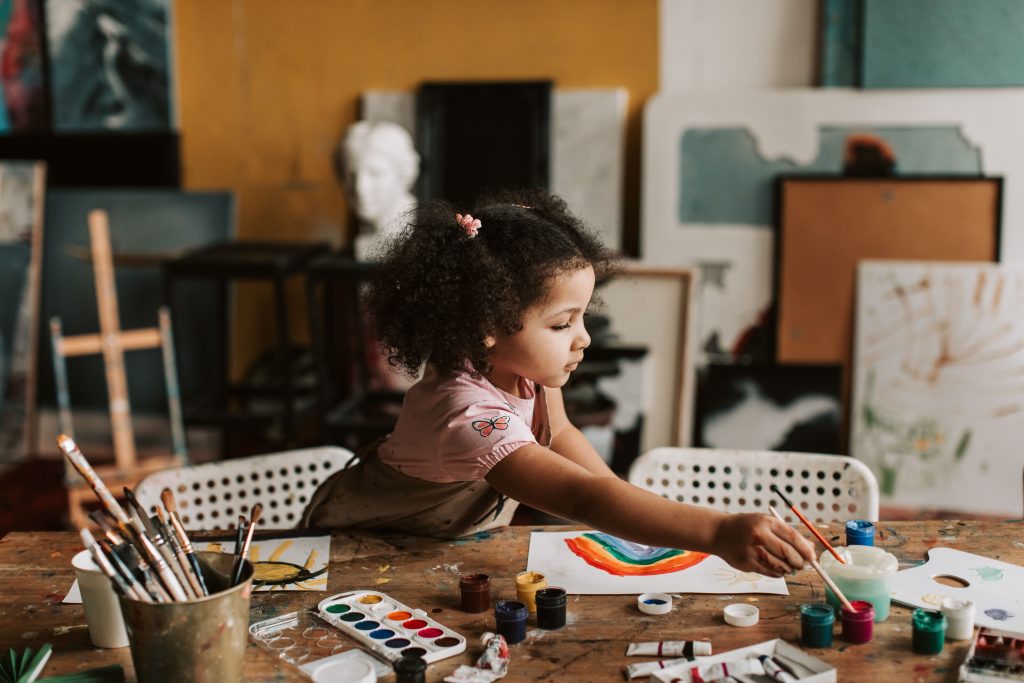
Choose materials that work across several activities. Colored pencils, washable markers, glue sticks, and tempera sticks need less room than bottles and large craft assortments. Keep one active bin accessible and store refills elsewhere. A folding table mat defines the work area, vertical holders protect paper, and a portable caddy helps siblings share supplies and simplify cleanup.
Make Creative Materials Easier to Use Independently
Keep a small selection of paper and familiar dry tools within reach, then rotate colors or media to renew interest. Store paints, sharp tools, and small components in a supervised area when needed. Picture labels help early readers, while a simple closing routine—cap markers, collect scraps, wash brushes, and move wet art—builds responsibility.
Common Buying Mistakes to Avoid
Do not confuse quantity with useful variety. A huge set may repeat crayons yet lack sturdy paper or practical storage. Avoid advanced media chosen mainly because online results look impressive. Start with a few reliable art supplies for kids, observe what gets used, and expand selectively. Also check refill availability before buying a case with custom components that are difficult to replace.
When to Replace or Refill Art Materials
Replace dried markers, cracked containers, damaged brushes, and tools that no longer work as intended. Discard unidentified contents or products with unreadable labels, and follow package directions for disposal. Refill according to use rather than completeness. Tracking fast-moving paper, paint, and marker colors prevents another full-set purchase when only one category has run out.
Frequently Asked Questions About Art Supplies for Kids
What basic art supplies should every child have?
A practical basic set includes crayons or colored pencils, washable markers, plain paper, child-appropriate scissors, glue, paint, and a few brushes. The mix should reflect age and interest. Toddlers need larger, simpler tools, while older children may benefit from graphite pencils, watercolor paper, oil pastels, or mixed-media components.
Are washable materials completely stain-proof?
No. “Washable” generally means a product should clean more easily from skin and many washable fabrics, but results vary by surface, fabric, treatment, and time. Protect porous furniture, follow the manufacturer’s washing directions, test uncertain surfaces, and use an art shirt or table mat for wet projects.
How many art supplies for kids should I buy at first?
Begin with one option from each useful category rather than a large collection. A drawing tool, paper, glue, scissors, paint, and brushes cover many activities. After several weeks, notice what your child repeatedly chooses. Add depth to that category instead of buying more materials only for appearance.
Are craft kits better than buying separate supplies?
Kits work well for gifts, travel, and children who enjoy variety. Separate supplies provide more control over quality, quantity, and replacements. A kit makes sense when most components suit the child’s age and interests. Otherwise, a smaller custom collection often costs less over time and produces less unused clutter.
How should I securely store my art supplies?
Keep everyday age-appropriate tools visible in shallow containers. Place small parts, sharp tools, solvent-containing products, or materials requiring close supervision out of reach. Retain original labels, close lids securely, and separate wet tools from dry materials. Storage should support both access and the supervision each item requires.
Final Recommendation: Choosing Art Supplies for Kids
The best art supplies for kids fit the child, the home, and the caregiver’s realistic cleanup capacity. Begin with age-appropriate basics, clear labeling, and replaceable essentials, then build around the media your child returns to. The Crayola Inspiration Art Case simplifies general drawing, while Ooly Chunkies Paint Sticks suit families seeking colorful painting with less setup. A child ready to compare several media may prefer the Faber-Castell Young Artist set.
You do not need the largest case or every trending craft material. Choose one well-matched set, add dependable paper and a few refills, and let real creative habits guide the next purchase. That measured approach keeps creativity accessible, storage manageable, and spending focused on supplies that will genuinely be used.