Top Parenting Books: Expert-Recommended Favorites
We may earn a commission for purchases made using our links. Please see our disclosure to learn more.
You know that moment when you’re trying to be patient, kind, and consistent… and then your kid melts down because you gave them the “wrong” banana? Yep. That’s usually when people start googling top parenting books.
And honestly? A good parenting book won’t turn you into a perfect parent (thankfully, because perfection is exhausting). But the right one can give you language, tools, and a calmer “next step” when your brain is running on fumes.
Affiliate note: This article includes an Amazon book roundup; if you add affiliate links later, you may earn a commission at no extra cost to you.
Why parenting books still matter (even if you’re tired)
Parenting advice is everywhere, but “everywhere” isn’t the same as “helpful.” The best parenting books do something social media usually can’t: they teach a system.
Also, parenting is stressful in a very real way—not just “busy,” but “how am I supposed to do all of this?” real. In the U.S. Surgeon General’s advisory (using 2023 data), 48% of parents said their stress feels completely overwhelming on most days.
So if you’re turning to books because you want support that’s calmer than a comment section—same.
A quick mindset shift
Think of a parenting book like a cookbook. You don’t read it to become a chef. You read it so dinner stops feeling like a daily emergency.
How to pick the best parenting book for your season
Before you buy anything, ask yourself:
- What’s my biggest pain point right now? (sleep, tantrums, talking back, screens, anxiety, routines)
- How old is my child—and what stage am I actually in?
- Do I want “warm + firm,” “gentle,” “structured,” or “data-driven”?
Choose one “core” book + one “support” book
Core book = your philosophy + daily tools.
Support book = your current challenge (toddlers, teens, neurodiversity, big emotions).
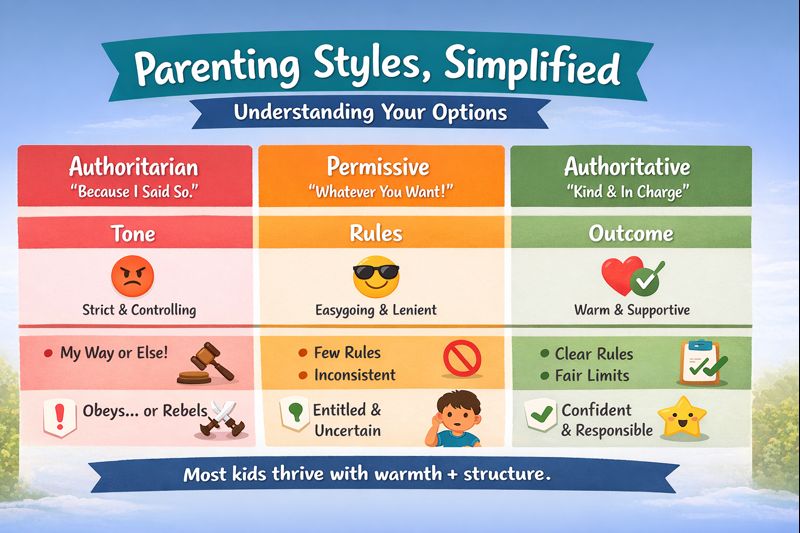
Parenting styles in plain English (so you don’t feel lost)
A lot of parenting advice books use labels that sound like a debate club. Here’s the simple translation:
- Authoritarian: “Because I said so.” (high control, low warmth)
- Permissive: “Whatever you want.” (low structure, high warmth)
- Authoritative: “I’m kind and I’m in charge.” (high warmth, clear boundaries)
Most evidence-based parenting approaches live in that last lane: warmth + structure.
Why this matters when choosing books
If a book makes you feel like a villain for setting limits… or like limits don’t matter… it probably won’t help you long-term.

Newborn + first-year survival: what to read first
If you’re expecting or deep in the newborn fog, you don’t need 12 books. You need one that stops you from spiraling at 2 a.m.
Look for books that:
- reduce decision fatigue
- explain what’s normal (and what’s not)
- help you feel confident, not judged
Tiny practical tip
Pick a book that’s easy to skim. Your brain is not built for dense chapters when you’re running on broken sleep.
Toddler power struggles: books that calm the chaos
Toddlers are basically tiny scientists: What happens if I scream? What happens if I run away? What happens if I say NO 47 times?
Good toddler parenting books teach you:
- how to set boundaries without turning every moment into a wrestling match
- how to offer choices without handing over authority
- how to stay calm while someone is sobbing about socks
Helpful reframe
Toddlers aren’t “giving you a hard time.” They’re having a hard time—and borrowing your nervous system.
Preschool + early elementary: building routines and resilience
This stage is where “cute” starts mixing with “why are we late again?”
Books that shine here focus on:
- family routines that stick
- emotional skills (not just behavior)
- teaching responsibility without shame
Try this tonight
Instead of “Stop that,” try: “What’s the plan?”
It turns correction into coaching.
Big feelings, anxiety, and confidence: emotionally supportive reads
Some kids feel things loudly. Some feel them quietly (and then explode later). Either way, books that talk about emotions are gold—especially if you grew up with “you’re fine, stop crying.”
You want tools for:
- naming emotions
- building coping skills
- helping kids feel safe and capable
A small but powerful add-on
If you want a gentle way to support confidence and emotional language at home, you can weave in positive self-talk. Here’s a kid-friendly list of affirmations you can say together (great for mornings, bedtime, or post-meltdown resets):simple affirmations for kids that build confidence
Communication tools that actually work in real homes
The best “talking” books don’t teach you to sound like a therapist. They teach you to sound like you, but calmer.
Look for:
- scripts you can borrow (“When you’re ready, I’m here.”)
- repair language (“I didn’t handle that well. Let’s try again.”)
- practical listening tools (that don’t take 30 minutes)
Mini script that saves sanity
“I won’t let you hit. You can be mad. I’m right here.”
Short. Clear. No lecture. Works in more situations than you’d expect.

Discipline that teaches: boundaries without blow-ups
Discipline isn’t “make them pay.” It’s “teach them skills.” (Because punishment without skills just creates… sneakier kids.)
Great positive discipline books help you:
- hold boundaries without threatening
- use consequences that actually connect to the behavior
- avoid long speeches that nobody absorbs
Sanity-saving rule
If you have to repeat something 10 times, it’s not a message problem—it’s a system problem. Books can help you build the system.
Siblings, blended families, and “fairness” drama
If you’ve ever heard:
- “That’s not fair!”
- “You love them more!”
- “They started it!”
…welcome to the club.
The best books here teach:
- how to reduce rivalry
- how to avoid “referee parenting”
- how to build connection one-on-one
Quick practice
Catch kids being helpful out loud.
Not in a fake way—just narrate it: “You handed your sister the marker. That was thoughtful.”
Neurodiversity-friendly and sensory-aware parenting reads
If your child is autistic, has ADHD, is highly sensitive, or struggles with sensory overload, standard advice can feel like trying to use the wrong manual for your actual device.
Look for books that:
- explain behavior through nervous system regulation
- emphasize collaboration and accommodations
- separate “won’t” from “can’t”
Gentle reminder
A “good” strategy that consistently fails isn’t proof you’re failing. It’s proof you need a different strategy.
Product picks: top parenting books
1) How to Talk So Kids Will Listen & Listen So Kids Will Talk (Adele Faber & Elaine Mazlish)
Why it’s a classic: It gives you real-life phrases for real-life moments—tantrums, defiance, bedtime standoffs, sibling drama.
Key features:
- practical “say this instead of that” language
- respectful listening + firm limits
- tons of examples you can copy immediately
Best for: parents of ages ~4–12, co-parents who want the same approach, caregivers who want fewer battles
2) The Whole-Brain Child (Daniel J. Siegel & Tina Payne Bryson)
Why it’s beloved: It explains what’s happening in your child’s brain in a way that actually changes how you respond.
Key features:
- brain-based strategies (simple, not “science-y”)
- connection-first tools that still keep boundaries
- visuals and short concepts that stick
Best for: parents who want to understand meltdowns, anxiety, or emotional reactivity
3) No-Drama Discipline (Daniel J. Siegel & Tina Payne Bryson)
Why it helps: It bridges the gap between “be gentle” and “please stop doing that.”
Key features:
- practical discipline steps built around connection
- tools for handling big behavior without big escalation
- strategies for repair after hard moments
Best for: toddlers through tweens; anyone trying to reduce yelling and power struggles
4) Cribsheet: A Data-Driven Guide to Better, More Relaxed Parenting (Emily Oster)
Why it’s different: It’s for parents who feel calmer with data—without shaming people who don’t do things “the one right way.”
Key features:
- breaks down common parenting decisions with evidence
- helps you stop doom-scrolling and start deciding
- a reassuring tone (more “coach,” less “judge”)
Best for: new parents, analytical parents, anyone overwhelmed by conflicting advice
5) The Montessori Toddler (Simone Davies)
Why it stands out: It’s practical Montessori at home—less aesthetic pressure, more real-life systems for independence.
Key features:
- how to set up routines that invite cooperation
- independence-building without harshness
- realistic examples for everyday toddler life
Best for: parents of 1–3-year-olds (especially if you want calmer mornings and fewer battles)
Bonus: confidence-building words for kids
Here’s the thing: kids often borrow our words until they can build their own inner voice.
So yes, boundaries matter. But so does the daily emotional “diet” your child hears:
- “You can do hard things.”
- “I’m proud of your effort.”
- “Let’s try again together.”
If your home tends to run anxious or perfectionist (or just busy), intentional affirmations can be like emotional handrails—small, steady support.
Research-backed: two evidence anchors worth knowing
You don’t need to turn parenting into a research project. But it is comforting to know that the themes in many top parenting books—warmth, consistency, and skill-building—match what studies find helps families.
Parenting interventions can reduce harm and improve long-term outcomes
A large systematic review and meta-analysis reported that parenting interventions can reduce physical and emotional violence against children, with effects maintained up to 24 months (though they may shrink over time). That supports a big message from many evidence-based parenting books: changing how we respond changes the whole home climate. (2023)
Read the review here: research behind top parenting books on effective parenting interventions.
Emotion-focused parenting support shows measurable benefits
Another meta-analysis found small to medium improvements in parents’ mental health and parenting behaviors, along with benefits for children’s internalizing and externalizing difficulties. In plain terms: helping parents respond to emotions differently can shift outcomes for both parent and child—exactly what communication- and regulation-focused books aim to teach. (2023)
Read the review here: evidence that supports top parenting books on emotion coaching and regulation.
FAQs about top parenting books + final encouragement
What are the top parenting books for first-time parents?
Start with one book that reduces decision overload (data-driven or practical) and one that builds your everyday communication skills. You’ll feel calmer fast because you’ll stop second-guessing everything.
Which parenting books help with discipline without yelling?
Look for books focused on “warm + firm” discipline, co-regulation, and consequences that teach skills. The best ones give you scripts and step-by-step tools for high-stress moments.
Are gentle parenting books good for setting boundaries?
Yes—if the book includes structure. Gentle doesn’t mean permissive. A good gentle parenting book will help you set limits clearly while staying respectful.
What parenting books are best for toddlers?
Choose books that focus on choices, routines, emotional regulation, and power struggles. Toddler books should be practical and skimmable—because toddlers don’t give you quiet reading time.
How do I actually apply a parenting book (and not just highlight it)?
Pick one tool per week. Put it on a sticky note. Use it during your most common struggle time (bedtime, mornings, homework, transitions). Small repetition beats big inspiration.
Conclusion (a quick heart-to-heart):
You don’t need to read all the top parenting books. You just need the right one for the chapter you’re in—and permission to learn gradually. Start with one book that feels like relief, not pressure. Try a few tools. Keep what works. Toss what doesn’t. And when you mess up (because you will, because you’re human), repair and reset. That’s real parenting. That’s the whole point.