Affirmations For Kids To Encourage Positive Development
We may earn a commission for purchases made using our links. Please see our disclosure to learn more.
If you’ve ever watched your child spiral over something “small” (a wrong answer, a wobbly friendship moment, socks that feel criminally uneven), you already know: kids have a loud inner narrator. And sometimes that narrator is… not exactly kind.
That’s when Affirmations For Kids can make a real difference. Not as cheesy “good vibes only” lines—but as simple, repeatable phrases that help your child practice a kinder, steadier way to talk to themselves.
In this guide, you’ll learn how to make affirmations feel real (not cringey), how to use them in daily life, and you’ll get tons of ready-to-use examples for confidence, worry, big feelings, and school.
What “Affirmations For Kids” really means
Affirmations are short, positive statements kids can repeat to themselves—out loud or in their head—to support positive self-talk, confidence, and emotional regulation.
But here’s the key:
They’re not magic spells. They’re more like training wheels for the brain.
A good affirmation helps a child:
- feel safe enough to try again
- name what’s true and hopeful
- build a healthier “inner voice” over time
Think of it like this: if your kid’s brain is a playlist, affirmations help you swap “I can’t” on repeat for something more supportive—without pretending life is perfect.
Why affirmations can help kids: the self-talk loop
Kids are constantly collecting “evidence” about who they are:
- “I’m the shy one.”
- “I always mess up.”
- “Nobody picks me.”
Those beliefs shape how they act, which shapes what happens next… and the loop continues.
Affirmations interrupt that loop with a new option:
- “I can be nervous and still try.”
- “Mistakes help me learn.”
- “I belong.”
No, a single sentence won’t erase stress. But repeated supportive self-talk can help kids respond with more courage and flexibility—especially during transitions, school pressure, or anxiety.
How to write affirmations that kids will actually believe
If an affirmation feels fake, kids sniff it out instantly. (They’re basically tiny lie detectors with snack requests.)
Use this simple formula:
Gentle truth + hopeful direction
Instead of:
❌ “I’m always confident!”
Try:
✅ “I can take one brave step.”
✅ “I’m learning to trust myself.”
Quick checklist for kid-friendly affirmations
- Keep it short (one breath)
- Use “I” statements
- Make it age-appropriate
- Avoid perfection language (“always,” “never”)
- Make it specific to the moment (school, bedtime, friendship)
When to use affirmations: tiny moments that matter
You don’t need a “perfect routine.” The best time is when your child’s brain is already talking:
- Before school: “I can handle today.”
- During homework frustration: “I can try a different way.”
- After a mistake: “Mistakes help my brain grow.”
- Before a social moment: “I can be kind and be myself.”
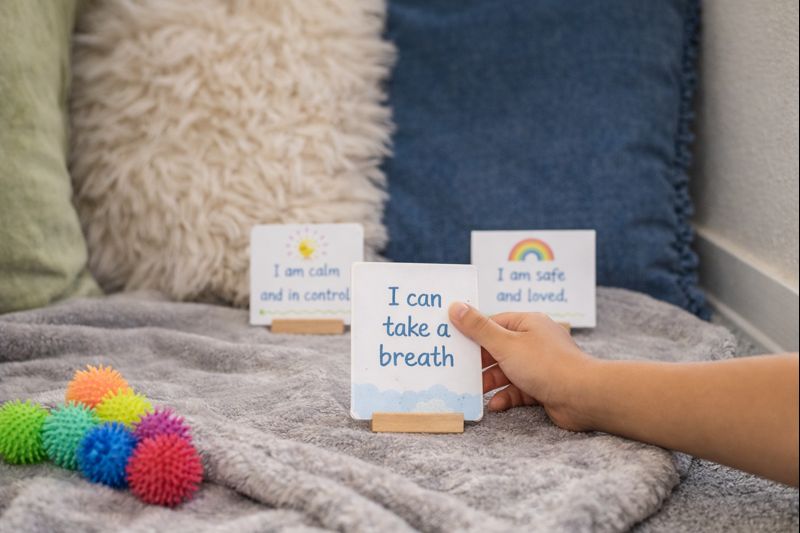
- At bedtime: “I am safe. I am loved.”
The goal isn’t constant positivity. It’s giving your child a steady phrase to reach for when emotions get loud.
Affirmations by age: preschool to tweens
Preschool (ages 3–5)
Keep it concrete and simple:
- “I am safe.”
- “I can try.”
- “I am loved.”
Pro tip: pair it with a gesture (hand on heart, big inhale).
Elementary (ages 6–9)
They can handle more “meaning”:
- “I can learn from this.”
- “I can ask for help.”
- “My feelings will pass.”
Tweens (ages 10–12)
They want autonomy and respect—no baby talk:
- “I can handle hard things.”
- “I don’t need to be perfect.”
- “I get to choose my next step.”
Morning affirmations for kids: an easy routine
If mornings are already chaotic, you don’t need another “task.” Make it frictionless:
Try a 20-second “Mirror + One Line”
While brushing hair/teeth:
- You say: “Pick one for today.”
- They choose: “I can do hard things.”
- You say: “Cool. Let’s go.”
That’s it. No TED Talk.
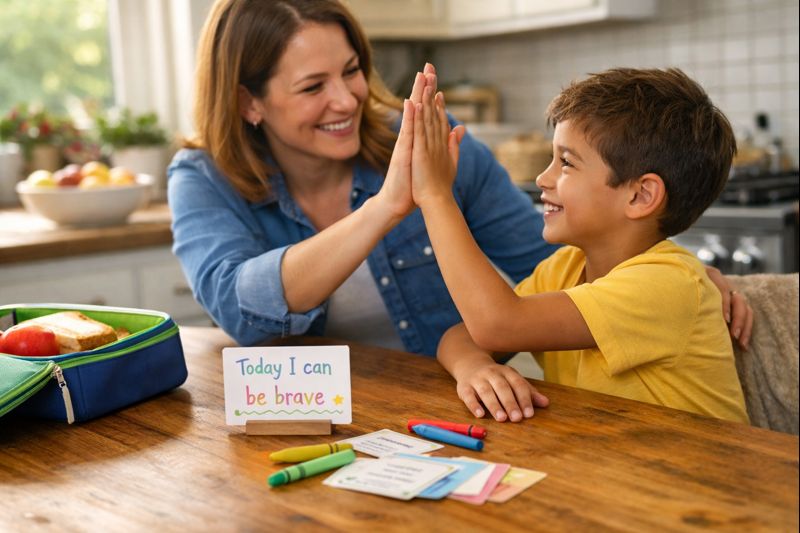
Extra easy: put affirmations where life already happens
- on the fridge
- inside the lunchbox
- on a sticky note by the shoes
Bedtime affirmations for kids: calmer nights
Bedtime is when worries like to sneak in. Use affirmations that signal safety and closure.
A simple 3-line bedtime set
- “My body can rest.”
- “I am safe right now.”
- “Tomorrow is a new day.”
Pair it with one slow breath per line. Kids often relax faster when the body feels involved—not just the words.
Confidence affirmations for kids who doubt themselves
Confidence isn’t “I’m the best.” It’s “I can handle this even if it’s hard.”
Try:
- “I can be brave and nervous at the same time.”
- “I believe in my effort.”
- “I can start small.”
- “I am proud of trying.”
- “I have strengths I’m still discovering.”
If your child rolls their eyes, that’s okay. You’re planting seeds.
Anxiety and worry affirmations for kids
Worry makes kids feel like danger is around every corner. Your affirmations should be grounding and present-focused.
Try:
- “This is just a worry thought.”
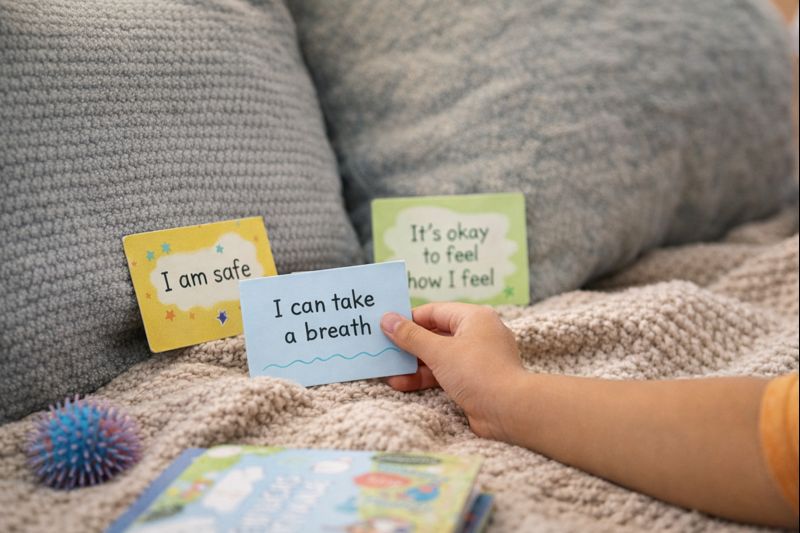
- “I can breathe calmly and allow it to fade.”
- “I am safe right now.”
- “I can handle one moment at a time.”
- “I don’t have to solve everything today.”
Helpful analogy: worry is like a smoke alarm—useful sometimes, but it can go off when you’re just making toast.
Growth mindset affirmations for learning and school
School can turn into “I’m smart” vs “I’m not.” Growth mindset affirmations keep the focus on learning.
Try:
- “My brain grows when I practice.”
- “I can learn this step by step.”
- “It’s okay to ask questions.”
- “Mistakes are part of learning.”
- “I can try a new strategy.”
These are especially powerful during homework meltdowns and test weeks.
Kindness and friendship affirmations
Friend drama can hit kids hard. These affirmations support belonging, boundaries, and empathy.
Try:
- “I can be kind while still protecting my boundaries.”
- “I deserve friends who respect me.”
- “I can apologize and make things right.”
- “I can choose good words.”
- “I belong just as I am.”
Body-positive affirmations and self-image
Kids absorb body messages early—sometimes from peers, sometimes from media, sometimes from overheard adult comments. Keep affirmations focused on respect and function, not looks.
Try:
- “My body helps me do amazing things.”
- “I treat my body with kindness.”
- “I am more than how I look.”
- “I can be healthy without being perfect.”
- “My body deserves care and respect.”
Affirmations for neurodivergent kids (ADHD, autism, sensory kids)
Neurodivergent kids often hear “too much,” “too loud,” “too sensitive,” “not trying.” Affirmations here should center dignity, support, and self-trust.
Try:
- “My brain works in its own way—and that’s okay.”
- “I can speak up about what I need.”
- “Breaks help me reset.”
- “I’m not ‘bad’—I’m having a hard moment.”
- “I can find tools that work for me.”
Make it practical (not abstract)
Instead of “I am calm,” try:
“I can take a break.” / “I can use my quiet tool.” / “One step first.”
Product Recommendations: Tools that make affirmations stick
Sometimes the format is the magic—cards, prompts, pop-open notes—because kids love novelty and choice. Here are five Amazon finds that are well-reviewed and easy to use:
1) Positive Affirmation Cards for Kids and Teens – 54 Affirmations + 150+ Questions (storage box)
What it is: A card deck with affirmations plus reflective prompts.
Why it helps: Great for kids who like talking things out.
Features: 54 affirmations, 150+ questions, sturdy box; strong review volume (4.7 stars, 512 ratings).
Best for: Ages ~7–13, bedtime chats, anxiety support, journaling starters.
2) Empowering Cards for Kids – Teaches Mindfulness, Affirmations, Self-Esteem, Relaxation & More
What it is: A mindfulness-focused deck that blends affirmations with calming skills.
Why it helps: It’s not just “say the words”—it pairs with regulation tools.
Features: Designed for kids; strong review volume (4.6 stars, 384 ratings).
Best for: Calm-down corners, therapy support, classrooms, emotional regulation.
3) Compendium ThoughtFulls for Kids — “You’re Amazing” (30 pop-open cards)
What it is: Little pop-open notes with uplifting messages (and space to write your own).
Why it helps: Tiny surprise = big impact. Kids love opening one.
Features: Pop-open format; huge review volume (4.7 stars, 1,857 ratings).
Best for: Lunchboxes, backpacks, “rough day” support, parent-child connection.
4) SpringFlower Lunch Box Notes for Kids – 100 Pack (inspirational/motivational notes)
What it is: Pre-written encouragement notes you can tuck anywhere.
Why it helps: Great when your child doesn’t want to “do affirmations” but will read a note.
Features: Bulk pack; strong review volume (4.6 stars, 377 ratings).
Best for: Busy parents, multiple kids, quick daily encouragement.
5) Big Life Journal Dream Affirmation Cards for Kids – 52 cards with display stand
What it is: Illustrated affirmation cards with a stand (nice for a desk or nightstand).
Why it helps: Visual kids love seeing the “card of the day.”
Features: 52-card set + stand; newer item so fewer ratings (5.0 stars, 42 ratings).
Best for: Visual learners, morning routine, kids who like decorating their space.
Bonus parent resource: If part of your affirmation routine happens on the go (hello, carline conversations), this guide to choosing a safe newborn car seat can help you feel more confident about your setup.
Research-backed: what studies say about self-affirmation
Affirmations for kids are basically “self-affirmation lite”—and self-affirmation has a real research history.
Study/Review #1: Self-affirmation and long-term benefits
A major review in psychology explains how timely affirmations can support outcomes in areas like education and well-being, with benefits that can last months—or longer. That idea matters for kids because it frames affirmations as small actions that can start bigger changes, not instant fixes. Read the review here: self-affirmation research behind affirmations for kids (Cohen & Sherman, 2014).
Study #2: Values-affirmation in school settings
A well-known school-based experiment tested brief values-affirmation writing exercises in middle school and found meaningful academic benefits for students under stereotype threat. While this isn’t the same as repeating “I am confident,” it supports the core point: helping kids reconnect to values and strengths can reduce threat and improve performance over time. See the paper here: values-affirmation study relevant to affirmations for kids in school (Cohen et al., 2006).
What this means for you: the most effective affirmations aren’t random compliments—they’re the ones that help your child remember who they are when stress tries to convince them otherwise.
FAQs about Affirmations For Kids
How do I start affirmations for kids if my child thinks it’s “cringe”?
Start indirect. Use lunchbox notes, “card of the day,” or say you’re trying one. Keep it short and casual—no speeches.
What are the best affirmations for kids with anxiety?
Go grounding, not hype: “I am safe right now,” “I can take one step,” “This feeling will pass,” “I can breathe.”
How often should kids say affirmations?
Aim for consistency over intensity. One in the morning or one at bedtime is plenty. The best frequency is the one you can actually keep.
Do affirmations work for younger kids who can’t read yet?
Yes—use simple phrases and repeat them during routines. Pair with a gesture (hand on heart, deep breath) to help it “stick.”
Should affirmations be in first person (“I am…”) or second person (“You are…”)?
Both can work. First person builds internal voice. Second person (“You are brave”) feels supportive—especially for younger kids. Mix them.
Conclusion
Affirmations for kids aren’t about raising a child who’s happy 24/7. They’re about raising a child who knows how to talk to themselves with kindness when life feels hard.
Keep it simple:
- one believable phrase
- one repeatable moment (morning, bedtime, school stress)
- one steady message: You can handle this—and you’re not alone.
Pick one affirmation to try this week, and watch what changes—not overnight, but little by little, where it counts.