
How To Discipline A Toddler Without Yelling

We may earn a commission for purchases made using our links. Please see our disclosure to learn more.
Your toddler throws a toy, refuses to put on shoes, or screams when playtime ends. You ask nicely, repeat yourself, and eventually feel your voice getting louder. If this sounds familiar, figuring out How To Discipline A Toddler without yelling can make everyday parenting feel less like a contest.
Discipline at this age isn’t about winning an argument or expecting perfect obedience. It’s about keeping your child safe while teaching skills they are still developing: waiting, listening, handling frustration, and respecting limits. That takes repetition.
This guide explains what to say during difficult moments, how to respond to tantrums and aggression, which consequences make sense, and how to build routines that reduce avoidable conflicts. You’ll also find helpful tools for daily routines.
Understand What Discipline Means for Toddlers
Effective toddler discipline teaches a replacement behavior rather than making a child afraid of getting caught. If your child draws on the wall, the lesson is that crayons belong on paper, followed by helping clean the mark when appropriate.
Young children are learning language, impulse control, and how rules work. Knowing a rule doesn’t guarantee following it when upset. Expect to repeat simple lessons, supervise closely, and respond consistently. Your calm voice keeps the boundary clear.
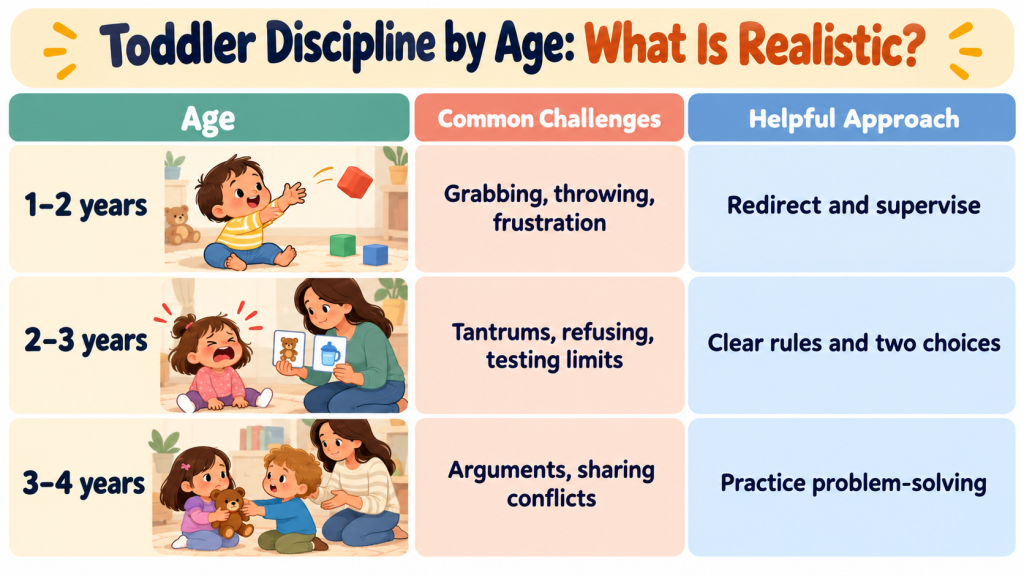
Look for the Need Behind Difficult Behavior
A tantrum after a missed nap calls for a different response than repeated toy throwing during an energetic game. Before correcting, consider hunger, tiredness, discomfort, overstimulation, changes in routine, or a skill your child hasn’t mastered.
Look for patterns without labeling your toddler. Does hitting happen when another child grabs a toy? Does screaming start just before dinner? Address the need while stopping the behavior. Offering a snack doesn’t excuse hitting.
How To Discipline A Toddler With Clear, Simple Rules
Choose a few rules your child can understand, such as “Gentle hands,” “Feet stay on the floor,” and “Food stays on the table.” Demonstrate them while calm.
State boundaries as actions rather than vague warnings. “Please put the blocks in the basket” tells a toddler more than “Be good.” For safety, act first: hold your child’s hand near traffic or move breakable items out of reach. Caregivers should use consistent language and follow-through.
Give One Direction and Two Acceptable Choices
Move close and make one specific request. “Put your cup on the table” is easier to follow than three instructions delivered from another room.
When possible, offer two acceptable choices: “Do you want the red shoes or blue shoes?” Both options lead toward leaving. Avoid offering a choice about a nonnegotiable issue, such as buckling a car seat.
If your toddler refuses, calmly repeat the direction once and help them complete it. Avoid drawn-out negotiations.
Pair Empathy With a Firm Boundary
Acknowledging a feeling does not require changing the rule. Try: “You’re angry because the TV is off. We’re finished watching today.” Your child may still cry, and that’s okay.
Keep your sentences brief and your tone calm and consistent. Offer a hug or stay nearby without insisting. Avoid bargaining while your toddler is overwhelmed. Feelings are welcome; unsafe actions aren’t.
Keep the limit reliable. If your child asks for something you cannot offer, explain what is available instead: “The cookie is for after lunch. You can have a banana now.” You are providing a clear answer, not starting a negotiation.
Handle Tantrums Without Adding More Noise
During a tantrum, focus on safety and connection before explanation. Move sharp objects away, lower your voice, and give your child some physical space if they need it. Try: “I’m here. We’ll talk when you’re ready.”
Don’t reward a meltdown by reversing a reasonable boundary simply to stop the crying. Equally, don’t ignore a child who is frightened, hurting, or asking for comfort.
Once they are calm, talk through what happened and practice a more helpful way to respond. Save longer lessons for afterward.

Stop Hitting, Biting, and Throwing Immediately
Aggression needs a prompt response, even when the feeling behind it makes sense. Gently block a hit or separate children, then say, “I won’t let you hit. Hitting hurts.” Keep your face and voice neutral.
Help the hurt child first if someone was injured. Remove a thrown object or end the unsafe activity, then demonstrate an alternative: asking for help, stamping feet safely, or saying “My turn.”
Don’t demand apologies during distress. Practice making amends later.
Choose Consequences That Teach, Not Humiliate
Use immediate, proportionate consequences related to the behavior. If blocks are repeatedly thrown, put the blocks away temporarily. If water is deliberately spilled, help your toddler wipe it up, allowing for their age and ability.
A brief, safe time-out is an option for certain serious rule violations, but it isn’t necessary for every tantrum. Distinguish distress that needs comfort from behavior that needs a firm consequence.
Avoid empty threats, shame, spanking, or withholding basic care.
Notice Cooperation Before Problems Escalate
Attention is powerful, especially when it describes a specific helpful behavior. “You waited while I finished pouring the water” tells your toddler exactly what worked. Offer affection without making everything a reward transaction.
Notice gentle touches, returning toys, and trying again. If a child whines safely for attention, you can briefly redirect your attention while remaining available, then reconnect as soon as they communicate appropriately.
Never ignore fear, pain, distress, or dangerous behavior.
Prevent Power Struggles With Predictable Routines
Transitions improve with predictability. Use familiar sequences for meals, cleanup, bathing, and bedtime. Give a simple warning before stopping a preferred activity: “Two more slides, then we go.”
A picture routine or visual timer can help children who don’t yet understand clock time. Allow time for shoes and goodbyes.
When they resist, keep the familiar sequence. Prevention won’t stop every tantrum, but it can reduce the number of surprises your child must manage.
Regulate Your Own Anger and Repair After Yelling
Notice a tight jaw, rushed speech, or rising volume. When your child is safe and supervised, pause, exhale, and use a prepared line: “I’m feeling frustrated. I’ll speak calmly.”
If you do yell, apologize without blaming your child: “I shouted. That wasn’t okay. I’ll try again.” The boundary still stands.
For more practical ways to manage those moments, read Parentloom’s emotional regulation strategies for parents.
If anger feels unmanageable, seek support from another caregiver or professional.

What Research and Pediatric Guidance Say About Discipline
The American Academy of Pediatrics’ 2018 policy statement on effective discipline, reaffirmed in 2024 advises against corporal punishment and harsh verbal discipline. Its recommendation centers on teaching behavior through positive, developmentally appropriate strategies rather than fear.
The CDC’s 2026 guidance on giving directions recommends simple requests, positive phrasing, limited choices, and consistent follow-through. Its time-in guidance distinguishes emotional distress, which may need connection, from harmful behavior that requires intervention.
A 2026 meta-analysis of psychosocial interventions found that parent-focused interventions reduced disruptive behavior among preschool and school-aged children. The studies tested structured interventions, not individual parenting phrases, and results should not be treated as proof that one script works for every toddler. Family circumstances, developmental differences, and the quality of implementation also matter.
Recommended Products for How To Discipline A Toddler
Tools can support routines, but cannot enforce boundaries. Choose one that addresses your family’s recurring challenge, and follow the stated age recommendations.
TIME TIMER Home MOD – 60-Minute Visual Timer Home Edition (Fern Green)
Best for: Making transitions easier to anticipate.
This compact timer shows time passing with a disappearing colored disk, so a parent can demonstrate when playtime will end without repeated reminders. It runs for up to 60 minutes and has a switchable alert. Toddlers need help interpreting it; the AA battery isn’t included.
Calm-Down Time (Toddler Tools® Board Books) by Elizabeth Verdick
Best for: Practicing soothing habits during calm moments.
This illustrated board book introduces breathing, asking for hugs, and using a quiet space for overwhelming feelings. Its short format suits shared reading with younger toddlers. It isn’t a tool for stopping an active meltdown on command; practice the ideas together when your child is receptive.
Learning Resources Big Feelings Pineapple Deluxe Set
Best for: Exploring facial expressions through play with children aged three and older.
Children build different expressions using changeable facial pieces on a double-sided pineapple, making feelings easier to discuss without a lecture. Storage in the pineapple is convenient between activities. The set contains small parts and is not suitable for children under three; adult participation makes the activity more meaningful.
Melissa & Doug Deluxe Wooden Magnetic Responsibility Chart with 90 Magnets
Best for: Tracking simple routines with older toddlers aged three and up.
This reusable wooden chart includes illustrated task magnets, encouraging adults and children to notice completed daily responsibilities. Choose just one or two concrete goals, such as putting toys away, rather than expecting an entire checklist. Adult guidance is needed; never penalize feelings with magnets.
How to Talk so Little Kids Will Listen: A Survival Guide to Life with Children Ages 2–7 by Joanna Faber and Julie King
Best for: Parents who want real-life language for cooperation and conflict.
This practical parenting book uses examples of everyday struggles, including brushing teeth, car seats, and sibling conflict. It offers communication approaches parents can try and adapt, rather than a single discipline formula. Because it is written for adults and covers a broad age range, you’ll need to select techniques appropriate to your toddler’s development.
Frequently Asked Questions About How To Discipline A Toddler
How do I discipline a two-year-old who doesn’t listen?
Get close, give one brief instruction, and show what to do. Check whether the task is within your child’s abilities before treating refusal as defiance. Offer a limited choice when possible, then follow through calmly. A two-year-old needs repeated practice and supervision; immediate compliance isn’t a realistic measure of successful parenting every time.
Should I ignore my toddler’s tantrum?
Don’t ignore a toddler who needs comfort, is unsafe, or is genuinely distressed. You may choose not to respond to minor attention-seeking whining while staying nearby and attentive to their needs. During intense crying, keep your child safe, offer calm presence, and avoid a long argument. Reconnect and teach the missing skill afterward.
Is time-out harmful or necessary for toddlers?
Time-out isn’t necessary for every family or every challenging behavior. Pediatric guidance describes brief, predictable time-outs as one possible response to certain harmful or serious rule-breaking behaviors. For distress or fear, a supportive time-in may fit better. Whichever approach you choose, avoid frightening isolation, humiliation, and prolonged separation.
What should I do when my toddler hits me?
Stop the hit safely and state the limit: “I won’t let you hurt me.” Step back or gently block further strikes without hitting back. Look for triggers such as frustration or difficulty communicating. Afterward, practice a specific replacement, like saying “Help” or tapping your arm gently. Seek professional advice if aggression is severe, persistent, or causes injury.
When should I seek help for difficult toddler behavior?
Speak with your child’s pediatrician when behavior regularly causes injury, seriously disrupts daily life, worsens sharply, or leaves you struggling to keep anyone safe. Ask about hearing, communication, sleep, developmental, or sensory concerns if relevant. Support may include developmental assessment or parent-focused behavioral guidance. You don’t need to wait for a crisis to request practical help.
Conclusion: Build Consistency Without Raising Your Voice
Learning How To Discipline A Toddler without yelling starts with manageable expectations. Use a few clear rules, give short directions, respond quickly to unsafe behavior, and help your child practice what to do instead. Comfort and consequences have different jobs; choose the response that fits the moment rather than treating every cry as disobedience.
A visual timer may help with difficult transitions, while Calm-Down Time offers a simple way to rehearse coping skills together. Neither will eliminate all resistance. Depend instead on predictable boundaries, attention to needs, and repair after hard moments.
Start with one recurring conflict this week. Decide the rule, the words you’ll use, and the calm action you’ll take when that rule is tested.